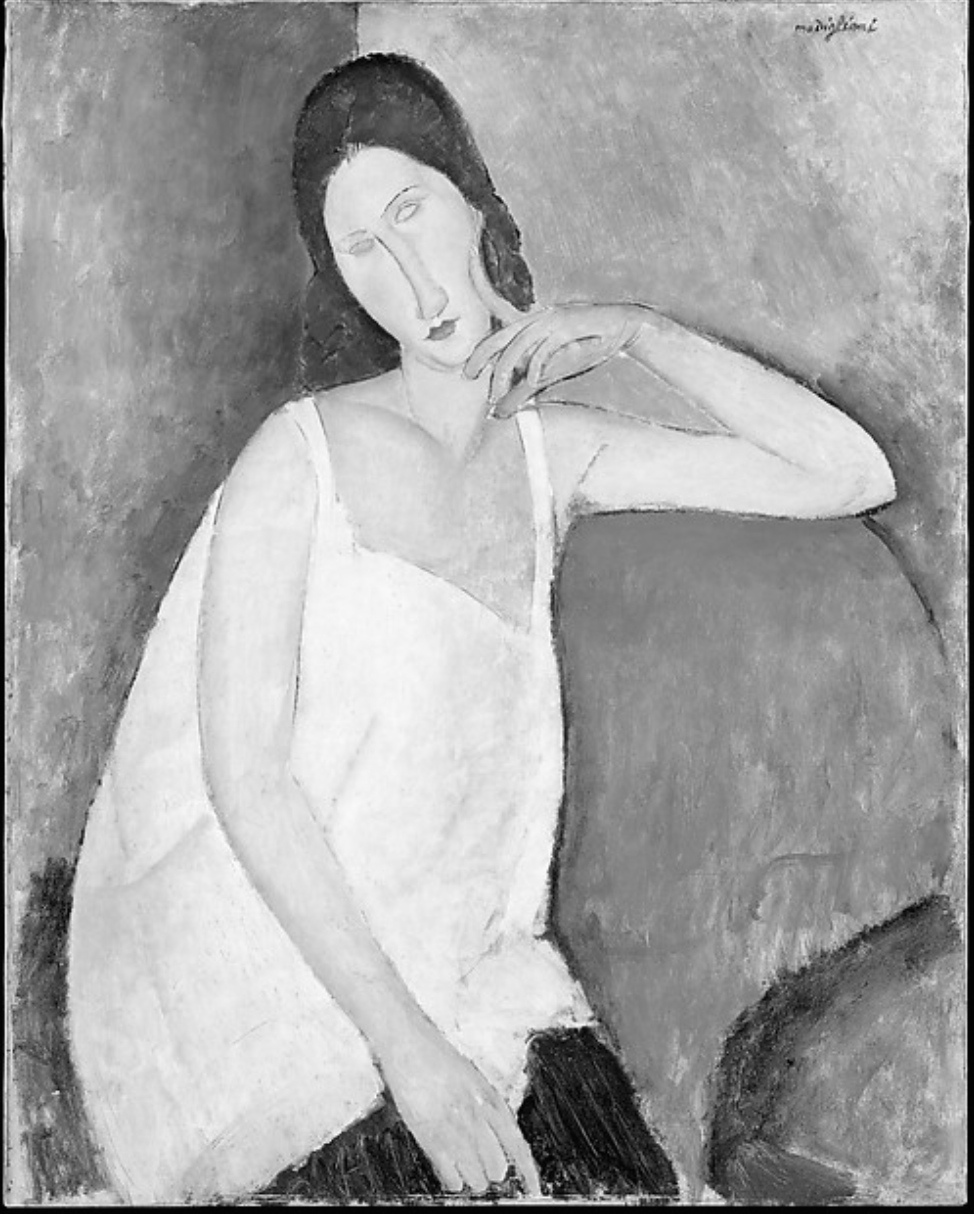
Review of Anthony J. Cascardi’s ‘Francisco de Goya and the Art of Critique’

By Christian Kile

http://www.sehepunkte.de/2023/10/38493.html
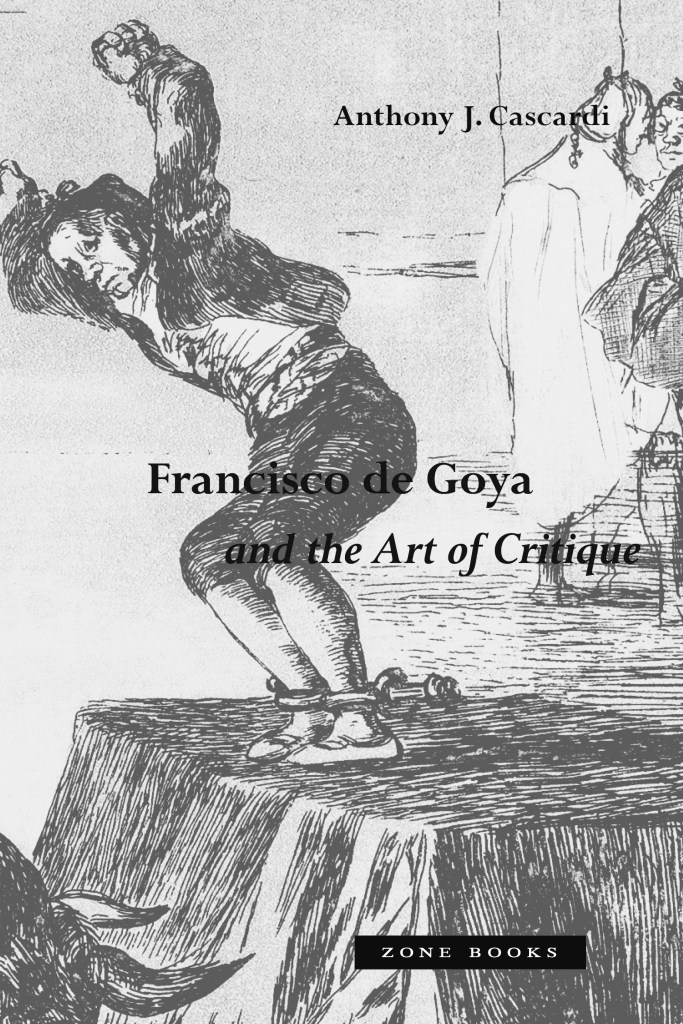
This ambitious study centres on a broad range of Francisco de Goya’s (1746-1828) work, along with its relationship to the elements of “modernity, Enlightenment, and critique.” (9) The author, Anthony Cascardi, concentrates on the artist’s paintings of polite society along with those mordant attacks on stupidity and cruelty in works such as the Caprichos and the Disasters of War, rejecting what he sees as the general view that it is mainly Goya’s darkest works which “establish his relevance for modernity”. (10)

Goya is presented as a man placed between an acutely backward Spain, lagging behind the more sophisticated civilisations of England, France and Germany which nonetheless also harbour the capacity to produce their own barbarity and limitations. Reacting to the forces of Enlightenment Europe and traditional Spain, Goya formed his project of “critique”, a technique that supplies to criticism a “self-conscious dimension that incorporates reflection on history, on tradition, on the underlying accepted categories and conditions of knowledge and belief, as well as on the medium through which these are represented.” (10)

The development of a secular nature in Goya’s work is introduced in the first chapter. His fresco, The Miracle of St. Anthony, with its stripped back religious elements, lack of a settled focal point for its subjects and its sky “vacant of anything heavenly”. (26) With his San Antonio commission that questions the traditional combinations of religious faith and painting technique, Goya may be seen as anticipating modernism, thus providing impetus for critical works probing both conventional methods of visual art and the world from which they supposedly came.

The critical strategy develops through Goya’s tapestry cartoons or large-scale oil sketches. Produced to convey “a distinctively Spanish social landscape”, certain of these works, despite their aspects of social harmony, are seen by Cascardi as including underlying elements of violence, “unsettling distortions of balance and perspective”. (55) There are intimations of the more biting images to come, like the Caprichos but Goya’s progressive political stance is somewhat repressed by the expectations of his court patrons.

To further define Goya’s contribution to a modern art, one committed to figuration and an ardent critical approach, Cascardi compares the Spaniard’s work with readings of Édouard Manet’s Execution of Emperor Maximilian, Goya’s The Third of May famously acting as its model. Another of Manet’s great images, the Dead Toreador is presented as a work of aesthetic modernism, moving away from reference to the world, reflecting on itself and “being nothing other than what it itself presents, and not anything in the world.” (95) On the other hand, Goya, with The Third of May, paints with intense emphasis a concrete event, one manifesting apparent revolt at the actions of a French regiment. Here the famous lantern at once illuminates this scene, aiding artistic representation, but also allows the regiment to make their kill. Such is the bind that the Enlightenment finds itself in, argues Cascardi, where its rationality tends to produce its own special kinds of barbarism, despite shedding a world of superstition. Within The Third of May we are presented with Goya’s own critique, that of modernity’s own flaws. Cascardi finds this tension present in Goya’s portraits too; the painting of Gaspar Melchor de Jovellanos at his Desk is said to portray a man dissatisfied by self-cultivation and a life of ‘good’ breeding. Neither are enough to stave off melancholy, boredom and scepticism.

Next, the Caprichos, an uncommissioned print series undertaken by Goya. Beginning with a self-portrait frontispiece, the remaining plates are split between the conscious or waking world, and that of nightmare. Between these two spheres, both producing their own kinds of horror, Cascardi provides some particularly engrossing readings of their text and images. The conventions of traditional perspective inherited from the Renaissance through to Velázquez give way to figurative wrenching and distortion, combined with the wit of Goya’s darkly comical captions. The critique element is seen to be born of the conviction that self-deception and virtually every other shortcoming are rife, and new methods for presentation of the world must be realised to divulge it. Critique is here defined by Cascardi as “a reflection on the limitations of the conventions of representation, including the difficulty involved in isolating a position within the social world from which to see the truths that society endeavors to hide.” (145)

Goya’s attitude towards secularization is developed further in a chapter contrasting him with the German philosopher Kant, described by the author as “wedded to the idea of reason’s autonomy […] he presupposed the irrelevance of the preexisting contexts of belief–contexts that reason saw itself as having successfully overcome.” (190)  Goya, on the contrary, made works which graphically expressed reason’s failure to achieve this Kantian design, continuing to be dogged by antiquated and base tendencies. Moreover, it could not supply an alternative salvation comparable with religion.

Goya is portrayed as an artist who feels something is terribly wrong with his world, and something ought to be done about it, but all he can do is make art about the spectacle. As Cascardi asserts, when considering Goya one should bear in mind that he challenged “the idea that any single framework of principles can underwrite the whole of cultural life.” (228)

With the Disasters of War Goya switches his gaze to “historical events” rather than the “social ones” of the Caprichos, events dealing with the most extreme violence. These works conjure both a vivid impression of wartime suffering, its mutilation and repercussions. The argument for Goya’s attitude towards Enlightenment’s deficiencies resurfaces, evidenced by French aggression, whilst the inability to turn back to a reactionary life associated with Spanish history make each unbearable in its own way. This impasse “contributes to the sense of cultural and historical dislocation in the Disasters.” (237)

Cascardi’s book complements the substantial list of earlier scholarship on Goya, through a blend of art history, intellectual history and the wider humanities. The volume integrates insights from major thinkers, expressly those of Kant and prominent writers on Goya, including Janis Tomlinson, Fred Licht, and Robert Hughes. [1] The discussion of the relationship between Goya’s tapestry cartoons and later works is especially absorbing, such as the comparison between, at first glance, the buoyant and refined Blind Man’s Buff [sic] and the crude state of aggression in the Black Painting, Duel with Cudgels.

Darkness is a word chosen frequently to describe Goya’s work. When he brilliantly exposes self-deception, wilful ignorance and corruption, it is not political,in the sense that no matter who is in charge, flaws remain, often horrifying ones, regardless of whether the artist finds a way of ‘out enlightening’ the Enlightenment.

Despite Goya’s respect and sympathy for the talents and actions of a few individuals, it is difficult to see the artist offering a panacea for the ills he pictured so mercilessly. Along with Cascardi’s admiration for the critical element of Goya’s nature, he chooses to close his chapter about the Black Paintings on a utopian note, where we encounter the author’s own bias or ideology. Throughout the book’s notes the thought of figures associated with the student upheavals of the sixties, thinkers like Althusser, Adorno, Barthes and Derrida, appear. The wide and varied range of texts contributing to Francisco de Goya and the Art of Critique suggests Goya lends himself, perhaps exceptionally, to extensive speculation, and in the case of this book prompts as much interest in the ideas of the author as its subject.

[1] Janis Tomlinson: Francisco Goya y Lucientes, 1746-1828, London 1994. Fred Licht: Goya: The Origins of the Modern Temper in Art, New York 1979. Robert Hughes: Goya, London, 2003.

Gwen John: Art and Life in London and Paris at Pallant House Gallery 13 May – 8 October 2023

By Christian Kile

https://newcriterion.com/blogs/dispatch/tone-poems

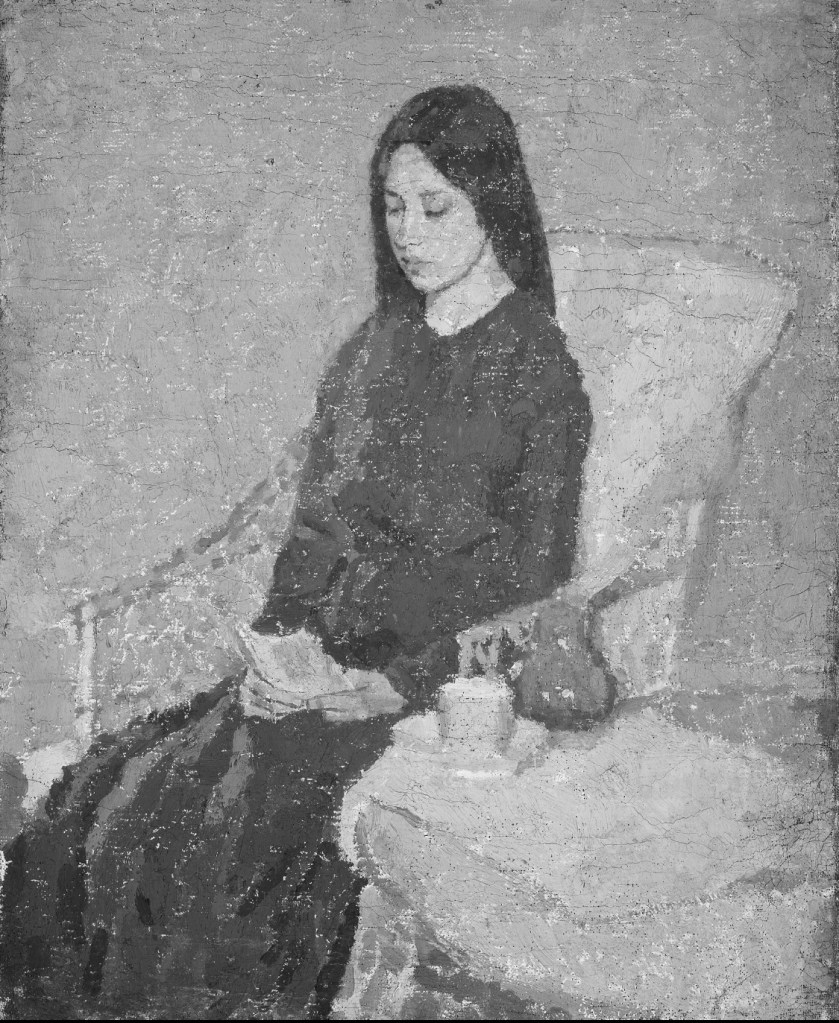
Gwen John, The Seated Woman (The Convalescent), c.1910–20. Oil on canvas. Ferens Art Gallery: Hull Museums

The essence of Gwen John’s art is summed up by her teacher James Abbott McNeill Whistler: tone. When her brother Augustus John talked about the character of her work, Whistler fired back, “Character? What’s that? It’s tone that matters. Your sister has a fine sense of tone.”

Whistler touched on something important. Gwen John’s penchant for more analytical methods, frequently returning to the same subjects, often emphasizing formal elements and with subtle variations, helps explain what makes her work so striking. Her paintings can convey a notion of “impersonality” or purity, a vital strand of modernism, more Continental in nature and closer to the maelstrom that came with the demolition of humanist optimism in the twentieth century.

Gwen John, A Corner of the Artist’s Room in Paris, c.1907–1909. Oil on canvas. Sheffield Museums Trust
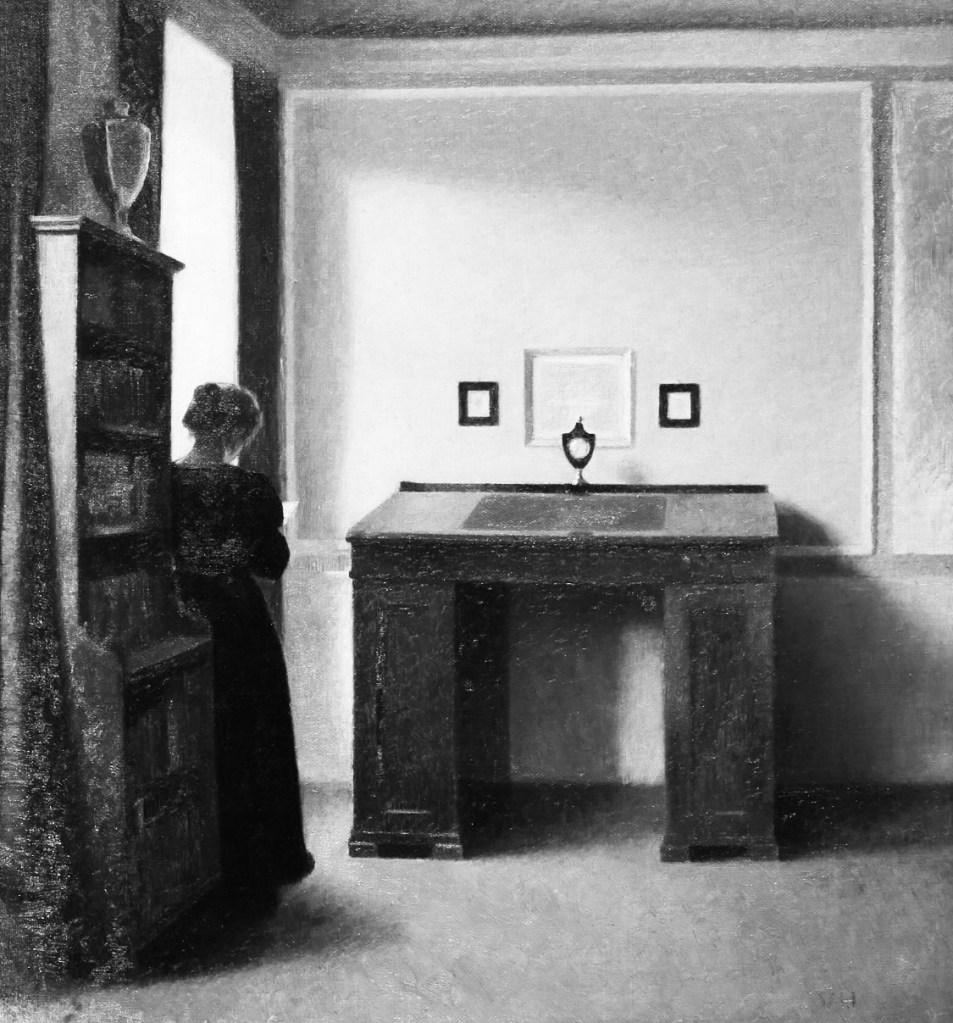
Vilhelm Hammershøi, Interior with Writing Table and a Young Woman, 1900, oil on canvas, private collection

Drawing and painting were a habit from her early years, and the strength of her draftsmanship is on display from the first room in a new exhibition at Pallant House Gallery, “Gwen John: Art and Life in London and Paris.” This is the first major showing of John’s work in twenty years, with oils, works on paper, archival material, and personal possessions. The full course of her career is traced chronologically, and the exhibition includes a select group of works from her contemporaries. In the second room, Vuillard and a marvelous Hammershøi hang close by a selection of John’s interiors. In one corner there is a small-scale plaster head by Rodin, Head of Whistler’s Muse (ca. 1906), a monument to Whistler for which John modeled.

As the show progresses there is in John’s work an increasing economy of style: whether still life, portrait, or interior scene, images tend to be expressed with a more muted palette; colors lighten, diffusing into patches with little voids of finely primed canvas emerging through strokes of oil paint. Society figures are absent. Often subjects are anonymous female sitters positioned within a sparse studio interior as in The Convalescent (ca. 1923–24), The Seated Woman (ca. 1910–20), and Girl in a Mulberry Dress (ca. 1923).

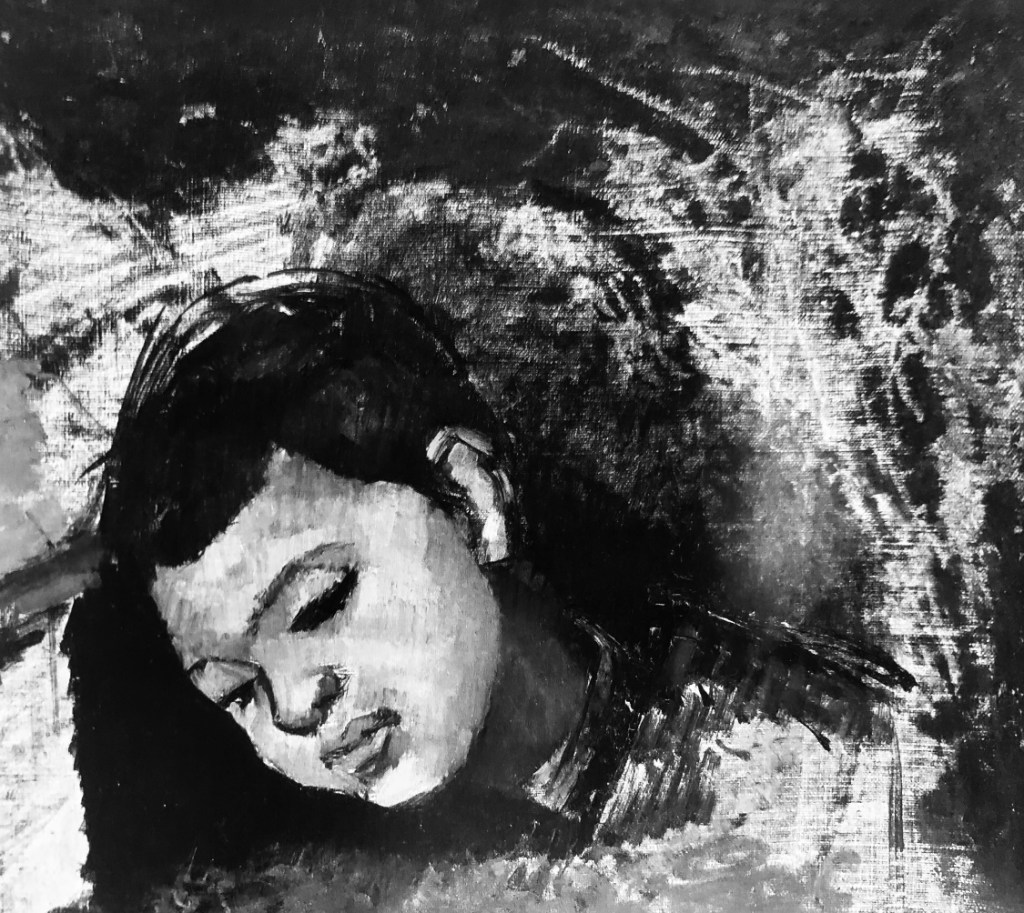
Many compositions are repetitive in John’s drawings and paintings, sometimes highly so—the variations between images, often portraits, remain within a particularly narrow range. Seeing these works as reproductions does them few favors but viewing the originals hanging together, the nuances of the paintings achieve a satisfying effect, notably in one room where they sit comfortably opposite Cézanne’s oil painting Head of a Boy (1881–82).

Paul Cézanne, Head of a Boy, 1881–2, oil on canvas, private collection
Gwen John, The Convalescent, c. 1923–4, oil on canvas, The Syndics of the Fitzwilliam Museum, University of Cambridge

“It is not unreasonable in Paris,” Paul Valéry observed, “to disguise what one has which is substantial and painfully acquired, under a lightness and grace which serve as a protection for the secret virtues of attentive and studied thought.” John’s art is often an embodiment of this insight. Despite her modest background, she established herself as an artist, becoming a recognized and respected figure in Paris during its modernist high tide. Following schooling at London’s Slade School of Fine Art, and further tuition under Whistler, she moved to France for good, living between the capital and its suburb of Meudon.

There on the continent, John found herself at a fountainhead of European modernism and became acquainted with many of its foremost figures: Picasso and Matisse, Braque and Wyndham Lewis, Brancusi and the poets Pound and Rilke. She became Rodin’s model and lover. It was a troubled affair, but, despite this he, like many others, esteemed her art.

This show does well to avoid focusing too much on John’s personal life as a means to understanding her art, rightly placing emphasis on her work. The once-overriding image of her as a recluse, apart from the avant-garde and intellectual currents of her time, is long gone. Given the marked increased focus on female artists in recent years, it’s surprising a figure this consistent has waited until now for a show of this standard.

The American lawyer and art collector John Quinn, an eminent enthusiast of John’s work, provided robust support, his period of patronage coinciding with her most prolific years as an artist (1910–24). He helped persuade John to part with her work as well as providing opportunities for her during wartime privations. Quinn said, “If I had to make a choice between the painting by you . . . and the Picasso, I should cheerfully sacrifice the Picasso.” Sometimes a little money and admiration are all that’s needed for encouragement.

During John’s final decade, her artistic pursuits apparently dwindled, and, due in part to illness, she became increasingly aloof and reclusive. Her work, however, remained desirable, and her family continued to offer support. The Brittany and Normandy coastlines were her retreat, and during a last visit to the sea she died in Dieppe at age sixty-three.

One leaves the show feeling John remains an underappreciated figure; putting this down entirely to her sex is unconvincing, for other twentieth-century female artists have gained much more notice. Without political diversions or manifestos, she knew her works were significant, and labored hard for them; perhaps she thought the personal cost too much and stopped her production early. Regardless of the cause, her self-imposed exile from the London scene and turn to Catholicism contributed to a body of work with an understated quietude. She reflected that for her, art came before children; who, she said, is remembered by history simply for becoming a mother?

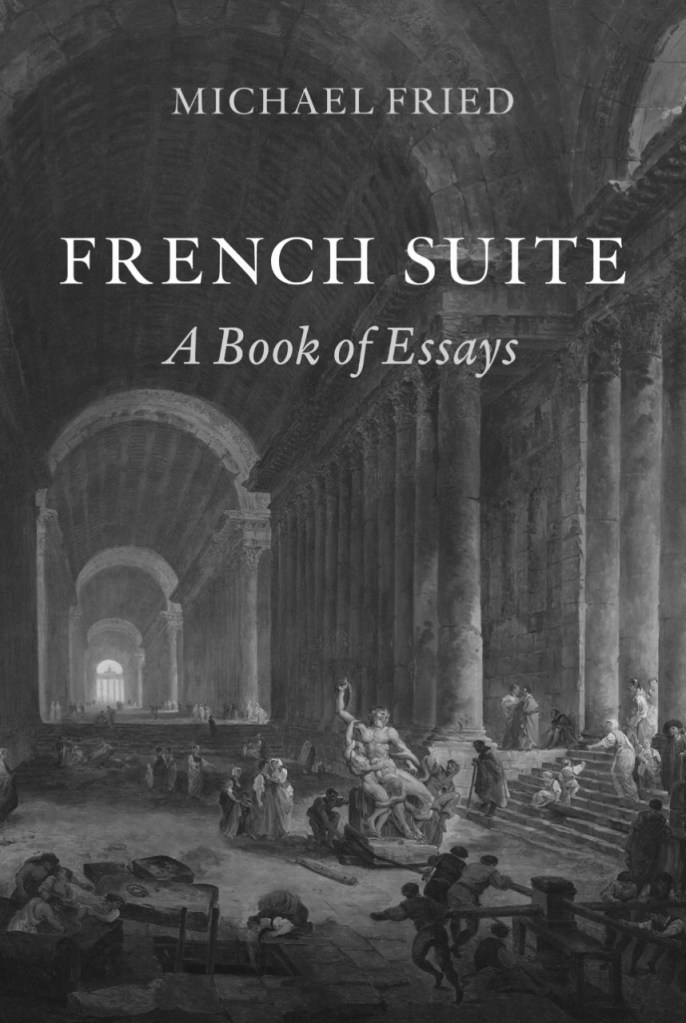
Review of Michael Fried’s ‘French Suite: A Book of Essays’

By Christian Kile

http://www.sehepunkte.de/2023/01/36992.html

This book of essays by Michael Fried covers a selection of the painting and literature of France, focussing on the nineteenth century and Impressionism together with an argument about the evolution of French art which led to it. The ideas of Denis Diderot, a long-time influence on Fried, are central in this collection. For it is in the philosophe’s art criticism that a key criteria of French painting became defined: a will to isolate itself from, or even deny the existence of its viewer or beholder – a rejection of what Fried terms “theatricality”. To achieve this, a method of “absorption”, depicting figures engrossed in their situation and an emphasis on “dramatic unity” to achieve “a compositional effect of closure vis-à-vis the beholder” became prominent (326-327). [1]

In the first chapter it is Louis Le Nain’s group of peasant paintings which come under study with their often “strongly frontal, not to say self-presentational orientation” of figures – works which form part of the “‘classical’ turn” initiated by Nicolas Poussin (25, 36). A number of these would be to hand for Édouard Manet “at the very moment, the outset of his career as a painter of major ambition, when he could best make use of them” (48).

In 1767, Hubert Robert, mostly remembered for his paintings of classical ruins, “provoked a seriously brilliant discussion” about his Salon submissions by Diderot, then said by Fried to be at his zenith as an art critic (51). Offering an alternative to the absorptive approach, Robert’s work is conceived as “pastoral”: bridges, walkways, tunnel like spaces and differing vantage points are all utilised; an approach that encourages a viewer to enter a picture (57).

It is that Romantic icon, Raft of the Medusa by Théodore Géricault in which the theme of absorption is intensified. Fried describes the painting as having been the artist’s sole attempt at a career defining achievement, and even then, one that apparently for the artist “fell painfully short” (114). Like Keats who died a few years before him, the Frenchman would die convinced that he had not fulfilled his promise. In the Raft the shipwrecked men or naufragés are desperately baying at a distant ship on the horizon away from the beholder. Fried goes further and speculates that judging by the men’s “actions and orientation” their rescue would result in them passing from the viewer, “as if we, in our capacity as beholders, were the ultimate cause of their predicament” (105).

Along with Flaubert, Baudelaire is one of the writers allotted a chapter. Fried focusses on the latter’s Salon of 1846 where the poet-critic’s great criterion of “memorability” and its “assumption that those works of art are best that leave the strongest and most lasting impressions on the memory” is considered (118-119). Good art, for Baudelaire, eschews explicit citation of past art: “only the experience of a ‘unified’ work in the present would sufficiently recall – would lend itself to being supported by memories of – ‘unified’ works from the past” (127). Therefore, according to Fried, it is curious that Baudelaire championed Delacroix whose works often bore “unconcealed relation to famous prototypes in earlier art” (151).

Manet’s two paintings, The Luncheon in the Studio and The Balcony, are seen to mark a highly significant shift in the artist’s work in which the presence of a viewer is acknowledged with a new force. Essentially, they are portraits of Manet’s stepson Léon Koëlla and close friend and fellow painter Berthe Morisot. They signal the abandonment of Diderot’s near century long theory of absorptive criteria to produce an effect of “radical facingness”, so achieving a new way for a painting to face its beholder and bringing an end to the antitheatrical project (212). [2]

Leaving aside the landscape paintings, Fried considers the lesser known figurative works of Jean-Baptiste-Camille Corot: usually women, the models are painted in various poses; reading, playing instruments, perhaps ruminating, contemplating, or just bored. Corot continued the tradition of portraying figures absorbed in actions or thinking even though, as Fried suggests, Manet’s interventions had already established that “absorption was no longer unproblematically available for antitheatrical purposes” (260). This thinking is in line with an early decision Fried took “to become an art historian of a particular kind”, developing a highly specific narrative of art from the mid-eighteenth century onwards, based on the principles laid out in his early essay, Art and Objecthood (1967) (12).

According to Fried the work of Charles-François Daubigny is the most “seriously misunderstood” of significant nineteenth century French painters, the result of a tendency to view it firmly through the lenses of Barbizon and Impressionism (278). The “sensation” aspect central to the latter is not prominent in his work (280). Rather he is seen by Fried as closer to Courbet, his paintings regarded by some contemporaries “as evoking an extraordinary range and intensity of sensory, which is to say bodily, impressions” (305).

Pushing on into “The Moment of Impressionism”, by far the most enjoyable chapter, Fried seeks to challenge the general consensus that this movement forms one more part of French paintings continuity. He argues instead that the shift to Impressionist landscape painting marks a “fundamental break” from the antitheatrical aim (326, 341). It would be in the 1860s that the question of “neutralizing of the beholder” became untenable, with Manet’s revolutionary figurative works ending the absorptive phenomenon, which began in the mid-eighteenth century according to Fried’s model (327).

In the case of Olympia, this new shift, combined with its prostitute subject, provoked particular notoriety. In response to a used-up tradition of “absorption” Fried makes his most striking claim, that Diderot’s antitheatrical and figurative theory is superseded by a “linked series of ‘formal’ issues and demands that had no single master critic or theoretician” (351). It was Manet’s monopoly on “facingness” that led to the momentous change of representation in the Impressionist landscape, altering the course of major painting.

For Fried this switch ushers in a great shift away from ambitious figure-painting – a phenomenon which to the present has “escaped comment by students of Impressionism” and led to a new kind of unity, achieved with smaller canvasses and raising “the issue of touch, along with that of finish, to a new degree of perspicuousness” (346, 351).

Having spent much of his “critical and art-historical career” discerning his own views from those of Clement Greenberg, one of the most prominent and plainly written twentieth century art critics, it is a shame that Fried, having acknowledged his predecessor’s essays on Cézanne, amongst others, as “incontournable” found himself “defeated” at the challenge of including an essay here on the artist’s painting Mont Sainte-Victoire and the Château Noir (Bridgestone Museum, Tokyo) (10, 356).

Fried goes into great depth about the “formal” aspects of paintings, characteristically drawing rigorously on responses from contemporary critics of his chosen period and “The Moment of Impressionism” in particular presents some fascinating ideas. While the claim that it is through landscape painters that “Impressionism has come popularly to be understood in our own time” may be true it is worth pointing out the importance of other genres within Impressionism and beyond, such as Renoir’s crowds and interior scenes, Cézanne’s still lifes and peasants, and much of Caillebotte and Degas (351).

Complimenting and drawing extensively from Fried’s trilogy on the relationship between painting and beholder: Absorption and Theatricality, Courbet’s Realism and Manet’s Modernism, French Suite does not suffer too much from ‘jargon’ but when the prose does get heavy it makes Diderot’s enraptured lines all the more welcome: “One never tires of looking. Time stands still for those who admire. What a short time I’ve lived! How brief was my youth!” (63). [3]


Notes:

[1] Michael Fried: Absorption and Theatricality. Painting and Beholder in the Age of Diderot, Berkeley 1980.

[2] Michael Fried: Manet’s Modernism, or, The Face of Painting in the 1860s, Chicago 1996.

[3] Cf. [1], [2] and Michael Fried: Courbet’s Realism, Chicago 1990.

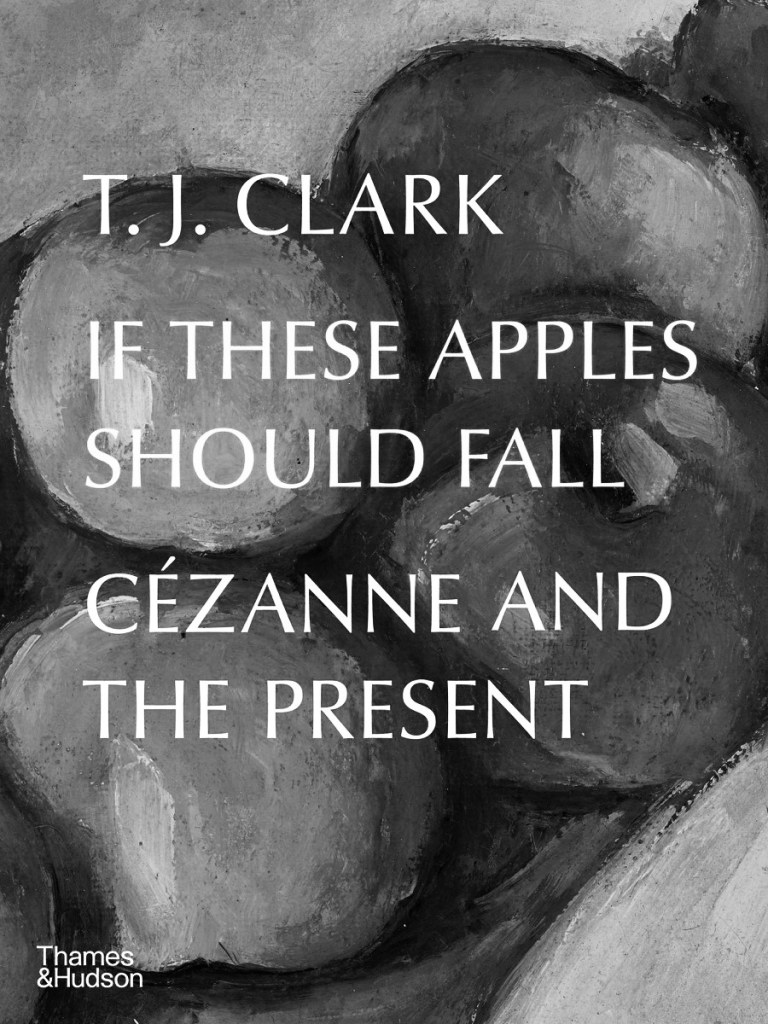
Review of T.J. Clark’s ‘If These Apples Should Fall: Cézanne and the Present’

By Christian Kile

http://www.sehepunkte.de/2022/11/37144.html

Establishing himself with two volumes on nineteenth-century French art during the Second Republic, Image of the People and The Absolute Bourgeois (1973), Timothy J. Clark took the ‘social history of art’ and refined it. His work rejected the idea of art as little more than the product of a broad context and offered closer, subtler readings, albeit with radical sympathies. The project aimed to explain the “links between artistic form, the available systems of visual representation, the current theories of art, other ideologies, social classes, and more general historical structures and processes.” [1] More work in this vein followed, most notably The Painting of Modern Life, concentrating on Impressionism and the Paris of Baron Haussmann’s reconstructions, then further into modernism and its demise with Farewell to an Idea.

Clark’s book on Paul Cézanne (1839-1906), If These Apples Should Fall: Cézanne and the Present has been years in the making, combining decades of looking and thinking about the artist. From Clark’s first memory of being struck by a reproduction of The Basket of Apples (c. 1893) the book includes chapters on Cézanne’s apprenticeship with Camille Pissarro, still lifes, landscapes, his relationship with the peasant world, and ends with the impact he had on Matisse’s work, The Garden at Issy (c. 1917). Painted during a time of world war and revolution, The Garden is said to have coincided with the period where Cézanne’s world, that of the nineteenth century, “was going down in flames” and Matisse knew it, the younger artist seeking out material from the French tradition which would prove usable, whilst Cézanne remained the “presiding deity” (17).

Despite Cézanne’s volatility in his early thirties, when he began working with Pissarro, he had already developed what Clark deems his “first style”, integrating “Courbet’s thick handling, Manet’s aggression and Delacroix’s cold lasciviousness” (23). Cézanne’s draw towards and imitation of Pissarro is seen as an attempt to transform what he had already achieved in a search for new forms, and to develop in his work the “petite sensation” – the precise meaning of which remains a mystery (42). Cézanne went as far as to closely copy one of his master’s larger landscape paintings, Louveciennes (1871), emerging as the greater artist, “more tragic and outlandish, more relentless and single-minded – and therefore modernity’s patron saint” (53).

The Getty Museum’s Still Life with Apples (c. 1893-95) provides a focal point in the second chapter. This work is accompanied by a series of detailed and wandering notes by Clark, ruminating on the painting and various other still lifes, sometimes running into trouble: “I followed the curves of the straw holder on the rum bottle for minutes – hours – on end. Even now I don’t know why” (69).

Interspersing formal readings of paintings with reflections on art historians including Kurt Badt and Meyer Schapiro, ideas from figures such as the anarchist critic Georges Lecomte and Rainer Maria Rilke, from Dante to Marx, Maurice Merleau-Ponty and Samuel Beckett, various ways into Cézanne’s works are sought. Presented as a series of notes, and with a wide range of references this section has a fragmentary quality, which seems fitting for one of the epoch’s major painters.

The chapters focused on landscapes and the card playing peasants offer more rigorous and at times insightful observations: one of the many paintings of Montagne Sainte-Victoire, from a private collection, is offered as a touchstone, “its vision of nature is both among the most openly, naively physiognomic Cézanne ever did […] The most like a body, the least like an organism. Dreamlike and machinelike” (114-115). However, there are a few long winded and abstract descriptions which do little to complement the paintings.

These protracted meanderings throughout the book remind one of the criticism made by Nicholas Penny, formerly director of the National Gallery in London, who viewed Clark as a “dangerous Marxist professor” whose prose can be “dense” and “elliptic.” [2] However, Clark’s choice of style could be explained when considering his attitude towards Clement Greenberg’s early writing, describing it as “forceful and easy, always straightforward, blessedly free from Marxist conundrums. Yet the price paid for such lucidity […] is a degree of inexplicitness – a certain amount of elegant skirting round the difficult issues, where one might otherwise be obliged to call out the ponderous armory of Marx’s concepts and somewhat spoil the flow of the prose from one firm statement to another.” [3] Stylistically, it sometimes feels that Clark has gone the other way with this book, employing dense language to avoid the shortcomings he perceives in Greenberg’s arguments. Belonging to a later generation and differing from Greenberg’s models, Clark’s arrangement of intellectual sources varies, and includes the work of theorist Paul de Man, whom he acknowledges as informing part of this book (229).

Describing Cézanne as the work’s “presiding deity” Clark discusses his place in the broader context of “modernist” art by looking at Henri Matisse’s painting The Garden at Issy (169). He argues that The Garden is almost “a deliberate art-historical marker” employed by Matisse as “palliative to the rest of the picture’s vertigo – that the little house in the garden is Cézanne. That is to say, a typical Cézanne moment” (187/189). Clark then compares The Garden with Cézanne’s Houses on the Hill (c. 1902-05).

It is at this point the book goes off at a tangent. Clark’s attention moves away from Cézanne’s influence on the Garden to other artists. A selection of explicitly political pictures is mentioned, revolutionary works from Varvara Stepanova and Jörg Immendorff. So too, is Monet’s own hedonism and Giotto with his “deep feeling for ‘nature in its barrenness'” (194). It is the Italian artist and his Dream of Joachim in the Arena Chapel that Clark views as Matisse’s “true inspiration – down even to the Cézanne-type house, since for me Joachim’s dark mountain hut finally trumps the more obvious source” (195). Although this detour doesn’t add much to our knowledge of Cézanne, it does provide an interesting insight into the author’s thinking.

The tone of Clark’s book is set with an epigraph from Ernst Bloch’s Geist der Utopie, and may be deemed provocative by some readers. Clark asserts Cézanne’s art “unthinkable […] apart from the grave dogged optimism of a long-vanished moment” (63). His work, The Basket of Apples “hates the object called modernity […] But not for a moment does the painting ask us to believe that its set-up will stave off the reality of the 1890s. Everything in the painting is falling – and where it falls to is where we are” (10).

Despite the book’s digressions and, by Clark’s own admission, “stodgy” sentences, If These Apples Should Fall provides an absorbing study of Cézanne for the early twenty-first century (117). But the fact remains that whilst the ideas are always interesting, the book is disjointed and lacks cohesion. Reading the accounts of various paintings one can appreciate the effort made to offer something fresh. Clark once observed that “left intellectuals, like most intellectuals, are not good at politics […] Intellectuals get the fingering wrong. Up on stage they play too many wrong notes.” [4] He isn’t wrong there. But they can write some intriguing books, and this is one.


Notes:

[1] Timothy J. Clark: Image of the People. Gustave Courbet and the 1848 Revolution, London 1973, 12.

[2] Nicholas Penny: “Geraniums and the River”, in: London Review of Books, Vol. 8 No. 5, 20 March 1986, https://www.lrb.co.uk/the-paper/v08/n05/nicholas-penny/geraniums-and-the-river [accessed 8 August 2022]

[3] Timothy J. Clark: “Clement Greenberg’s Theory of Art”, in: Critical Inquiry, September 1982, Vol. 9, No. 1, 141.

[4] Timothy J. Clark: “For a Left With No Future”, in: New Left Review 74 March/April 2012, https://newleftreview.org/issues/ii74/articles/t-j-clark-for-a-left-with-no-future [accessed 8 August 2022]

On William Hogarth

By Christian Kile

‘He was not really a cynic or a misanthrope; he was a pugnacious individualist with a strong sense of moral justice and a love-hate of the human animal.’ Essayist Charles Lamb about William Hogarth (1697-1764)

William Hogarth retains his popularity today as a painter, draughtsman and master storyteller, triumphing in his endeavour “to treat my subjects as a dramatic writer: my picture is my stage and men and women my players.”

Besides the meticulous characterisation, satire and narrative detail that define so much of his work, his idiosyncratic interpretation of beauty’s attributes in his treatise The Analysis of Beauty and the prescient ‘impressionistic’ element of The Shrimp Girl painting, audiences today appreciate the self-made artist behind them, of whom Charles Lamb said: ‘Perhaps next to Shakespeare, the most inventive genius which this island has produced.’

To some extent his rise mirrored that of other upwardly mobile professionals who were able to take advantage of a rapidly developing economy. Indeed, he was happy in his later years to accept Royal patronage when he became Serjeant Painter to the King in 1758. But within a short time the position was tainted by a new political populism and Hogarth ironically found himself on the wrong side and was viciously ridiculed.

Then, as Hogarth’s fame declined and his desperation increased to have the Establishment acknowledge the status of the ‘Comic Muse’, he crossed swords with Joshua Reynolds, founder and first president of the Royal Academy. By now criticisms about the ‘ugliness’ of Hogarth’s work had truly taken hold, as it was clearly at odds with the Establishment’s ‘Grand Style’ of painting promoted by Reynolds.

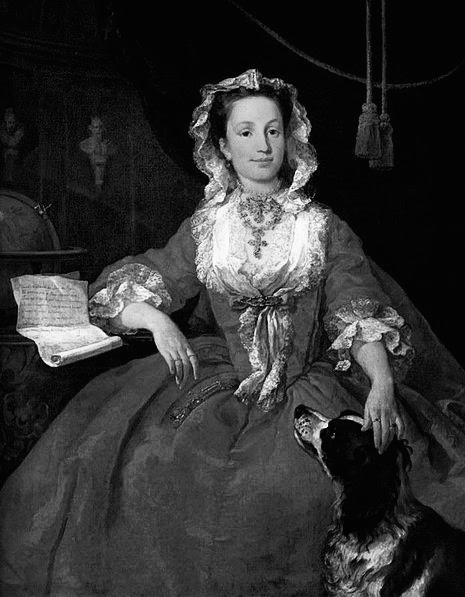
One should not assume that Hogarth was adept only at satire. His acute observation of people can be seen in his lesser-known individual society portraits, a thoroughly conservative form of painting, as his depiction of Miss Mary Edwards in the Frick Collection demonstrates – the memory of which persists from my visit to New York four years ago.

William_Hogarth_-_Portrait_of_Mary_Edwards_-_WGA11461

Miss Mary Edwards, 1742, Oil on canvas, The Frick Collection

Hogarth lived through a time when Britain was becoming a dominant force in painting, the development of its distinctive tradition coinciding with the island’s growing commercial power.

In contrast, France, with its decadent monarchy, was seen as ceding its position of cultural supremacy, a situation that Hogarth played on. In his earlier years he deliberately distanced himself from what he saw as French and Italian affectation. New groups intent upon acquiring art, often prints, were forming and Hogarth benefited from this. Works were not only visible in shops but also advertised in newspapers. This coincided with the periodical novels appearing towards the mid-18th century.

O the Roast Beef of Old England ('The Gate of Calais') 1748 by William Hogarth 1697-1764

O The Roast Beef of Old England (‘The Gate of Calais’), 1748, Oil on canvas, Tate

Concurrently the ‘modern’ novel was evolving. Although not wildly popular today, the novels, Pamela and Tom Jones, are still read. ‘Turgid’ is a typical response to Richardson’s novels nowadays. But though these stories may not appeal stylistically, in common with Hogarth, the subject matter was relevant to the middle class.

During the previous two centuries, much of the nation had little or no access to art, a legacy of the Reformation. Hogarth was pivotal in rectifying this. He was popular because his work was and remains accessible – people who say they do not usually go in for art typically find something to appreciate.

A less severe Goya, Hogarth relished exploring, observing and criticising his society. Moral instruction and critiques of human folly are expressed through paintings and prints, shot through with his characteristic humour. This occasionally gives way to a more ruthless satire on poor conduct, a theme that has come to define his better-known works.

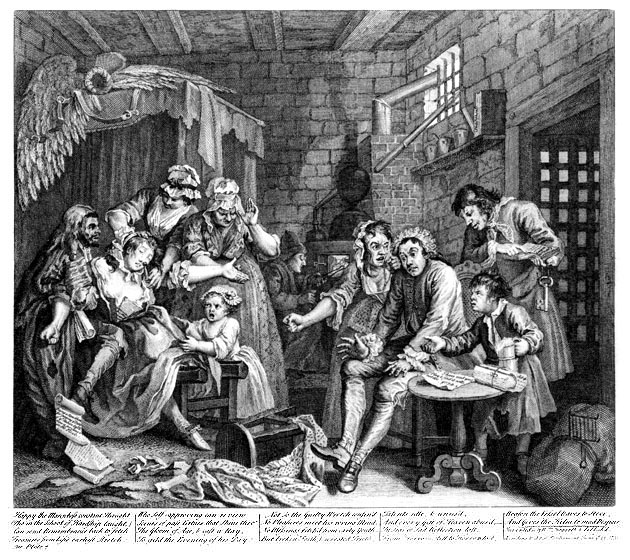
Hogarth’s images elicit the depravity and schadenfreude borne out of the 18th century social climate: such as the abject failure of a man foolishly adopting the behaviour of a higher social group and ruining his life utterly and the two ladies of leisure observing inmates for entertainment in the Rake’s Bedlam scene.

Hogarth recognised that mistakes and failures could be rich subjects for artists desiring to secure a place in history. Just think of his cycles created in the 1730s and 40s: A Harlot’s Progress, A Rake’s Progress, Marriage A-la-Mode, and Industry and Idleness, all of which have retained their appeal and remain among his most admired works.

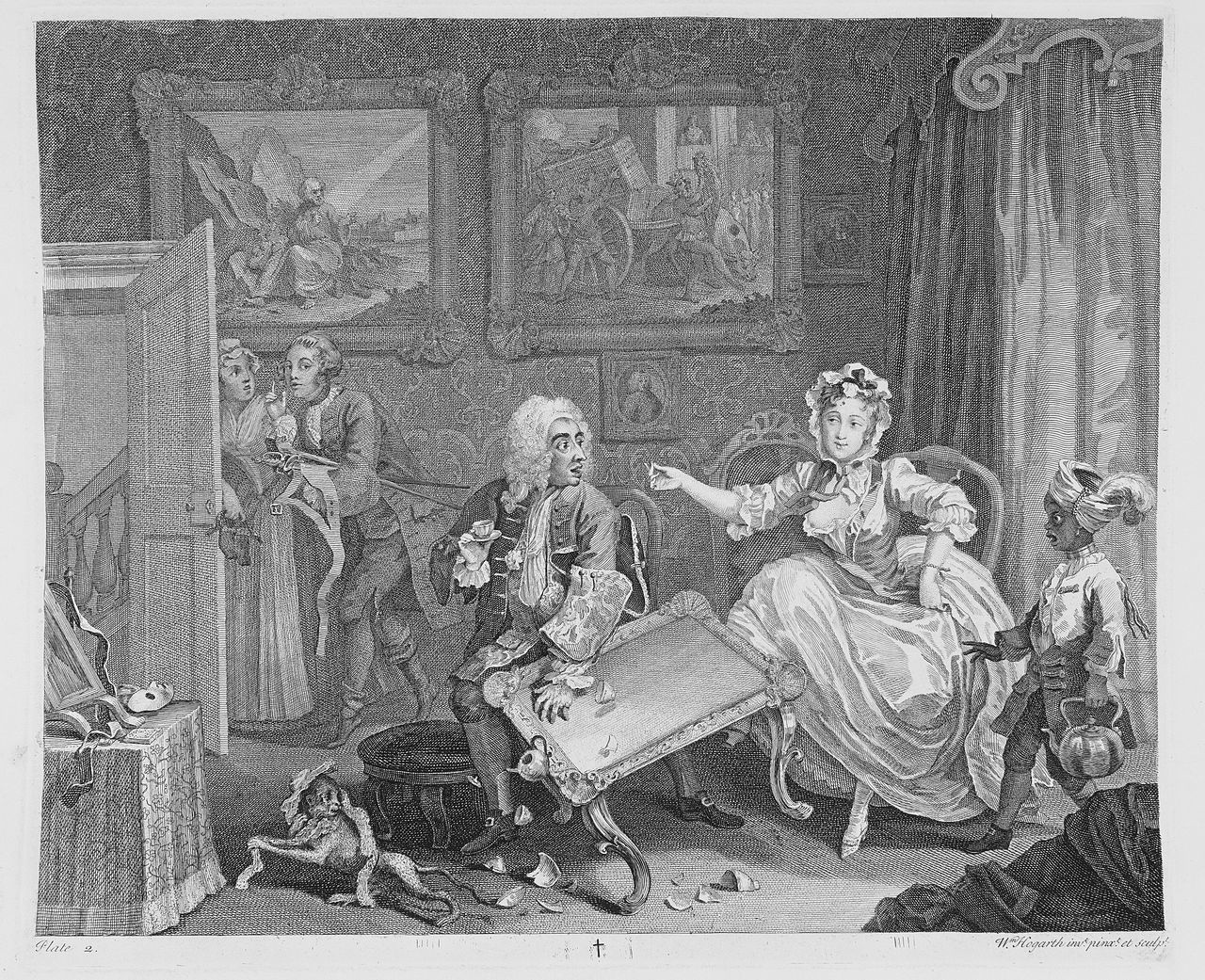
A_Harlot's_Progress2

A Harlot’s Progress (plate two), 1732, Etching and engraving, The British Museum

For those who thought Hogarth revelled in the degradation he depicted, Henry Fielding had a ready answer: ‘We are much better and easier taught of what we are to shun, than by those which would instruct us to what to pursue…We are more inclined to detest and loathe what is odious in others than to admire what is laudable…On which account, I esteem the ingenious Mr. Hogarth as one of the most useful satirists any age hath produced…’.

In Hogarth’s most famous satirical works city life is portrayed as a character in its own right – one that he knew intimately. He was born in 1697 and died in 1764 at his home in Leicester Fields, now Leicester Square and his art is inextricably associated with London. Born and raised there, Hogarth became one of the foremost chroniclers of political, cultural and social eighteenth century life in the metropolis. The settings are numerous and range from the tavern and prison to the upper-crust drawing room, from the street corner to the whorehouse.

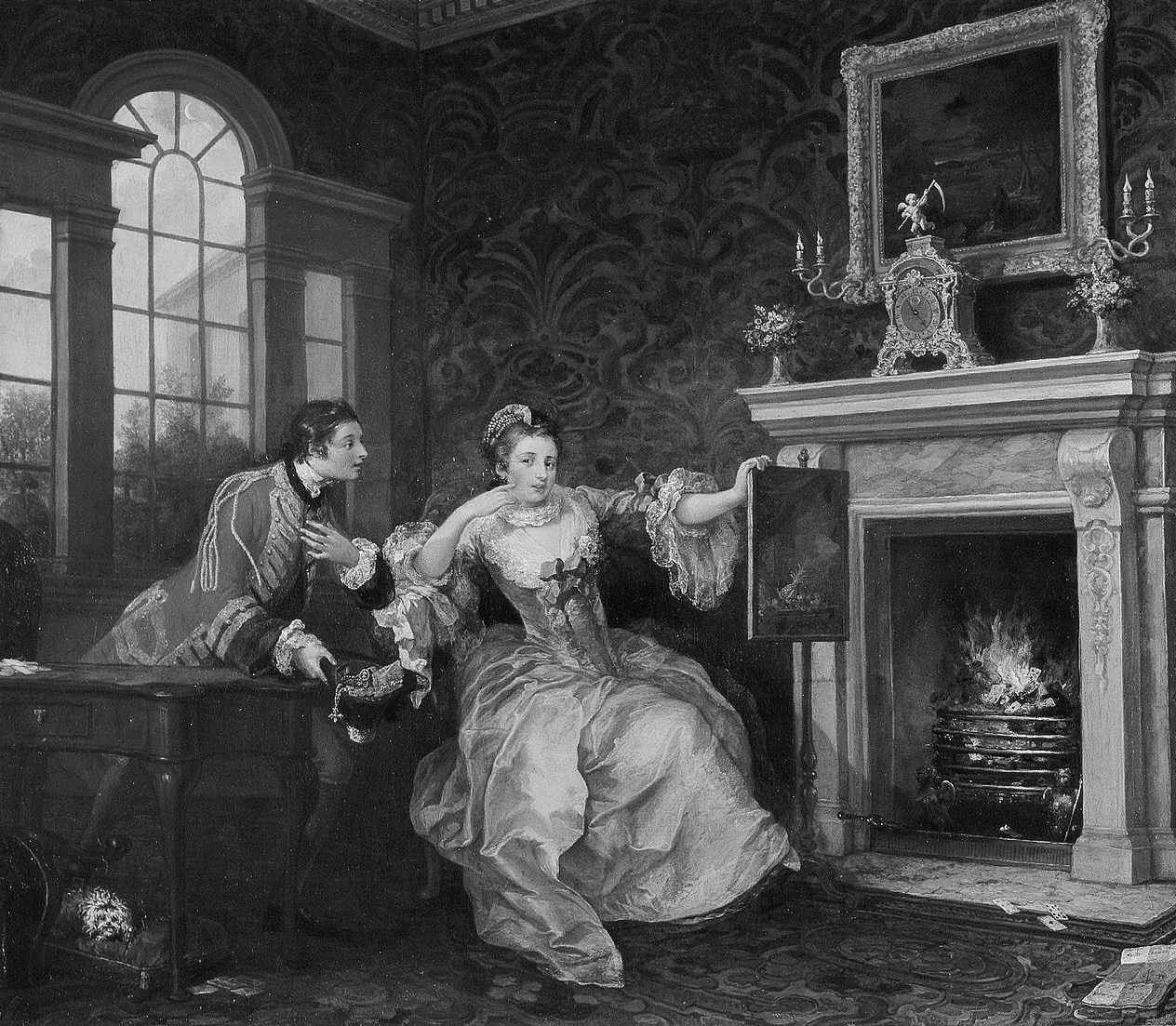
William_Hogarth_-_The_Lady's_last_stake,_c.1759

Piquet: or Virtue in Danger (The Lady’s Last Stake), 1759, Oil on canvas, Albright-Knox Art Gallery, Buffalo

Whether politicians or prostitutes, rogues or well-heeled, poor or somewhere in between, they can be found in Hogarth’s work. In his scenes comedy rubs shoulders with tragedy and wit with moral instruction.

William Hazlitt observed: ‘I know no-one who had a less pastoral imagination than Hogarth. He delights in the thick of St. Giles’s or St James’s. His pictures breathe a certain close, greasy, tavern air’. Today, some of his best-known works can be seen close by in The National Gallery and Sir John Soane’s Museum.

Hogarth catered to a varied public: Industry and Idleness and The Four Stages of Cruelty for the lower orders, while The Rake’s Progress and Marriage A-la-Mode served as a reminder that a misguided middle-class, hell bent on individual social ascent, were not beyond retribution. But his series were a warning and erred on the side of instruction rather than offensiveness, for artists do not enjoy losing clients.

A growing portion of society was very much concerned with individual rights and puritan morality; they believed that ambition and spurning vice would lead to riches and fulfillment.

While Hogarth’s work did not slavishly follow this line, he, like his friend, the novelist Henry Fielding, held to this type of morality, which he personally demonstrated by his own industry and diligence.

‘A true English Genius in the Art of Painting has sprung and by natural strength of himself chiefly, began with little and low-shrubb instructions, rose, to a surprising height in publick esteem and opinion.’ noted George Vertue, English engraver and antiquary.

Beginning as a silversmith’s apprentice, Hogarth gained his independence as an engraver and then painter, achieving prosperity and prestige – the very model of the sensible self-made man. One might conjecture that his driving force and adult railing against the ills of society derive from his father’s failed career as a man of letters. When Hogarth was ten, his family began a four-year stint in debtor’s lodgings.

William_Hogarth_-_A_Rake's_Progress_-_Plate_7_-_The_Prison_Scene

The Rake in Prison (plate seven), A Rake’s Progress; Tom is in The Fleet debtors’ prison, 1735, Etching and engraving, The British Museum

Hogarth revered Milton, Shakespeare and his contemporary Jonathan Swift, whose satires were much more scathing and pessimistic than his own. In turn his own art was admired by prominent figures of the age: Irish novelist Laurence Sterne, actor David Garrick and Swift himself.

At one stage two patrons, Lord Charlemont and Sir Richard Grosvenor offered him the opportunity to produce work on any subject he chose and to name his price. But not everyone was so enthusiastic. Even though politician and man of letters Horace Walpole collected Hogarth’s work, compiling the largest contemporary collection of his prints, he deemed the artist a commoner whose inclusion of the crass and common were subjects too lowly for his tastes. Walpole described the images of Gin Lane as ‘horridly fine, but disgusting’.

But as critic and essayist William Hazlitt pointed out: ‘Criticism has not done him justice, though public opinion has.’

Hogarth epitomised the artist as astute businessman. He was an anti-Jacobite (against the restoration of the House of Stuart) unless the opportunity to gain greater favour presented itself and anti-foreigner, although he did admire examples of continental art.

Practically, he pushed for a copyright law to prohibit the pirating of engravings, specifically to protect his own. The situation had reached such a pitch that pirated prints were known to be pirated again. This law was passed in 1735 with Hogarth retaining his new prints until then – among them A Rake’s Progress.  Seamlessly he switched between painting and engraving, whichever offered the best prospects, as well as proving an effective way to advertise his offerings.

Hogarth’s cycles of oil paintings were troublesome to sell, whereas his printed scenes proved extremely popular, A Harlot’s Progress in particular: whoredom, it makes clear, results in suffering and death, not a meal ticket. The descent of the Harlot or Mary Hackabout takes six scenes compared to the rake’s eight.

Scene one already presents us with a procuress, while a figure in the background looks on and fondles himself. In the second scene of her descent, Mary has been transformed from the innocent provincial maiden and transported into Babylon where as a whore she has penetrated high society. Amid gilt furniture and oil paintings the urban rot has set in.

I last saw the Harlot’s Decline in the V&A’s British Galleries, where the full print cycle hangs on one wall. Seeing the first image conjured up a few lines from Michel Houellebecq’s late 20th century novel, Atomised:

‘The terrible predicament of a beautiful girl is that only an experienced womanizer, someone cynical and without scruple, feels that he is up to the challenge. More often than not, she will lose her virginity to some filthy lowlife in what can prove to be the first step in an irrevocable decline.’

Hogarth’s engravings, cheap and available to a wide public, earned him his main living and brought wide recognition. He told stories that in his best-known works were created for the many and understood by this audience.

Of The Four Stages of Cruelty, he said: ‘The leading points in these, as well as Beer Street and Gin Lane, were made as obvious as possible, in the hope that their tendency might be seen by men of the lowest rank and the fact is that the passions may be more forcibly expresst by a strong bold stroke, than by the most delicate engraving.’

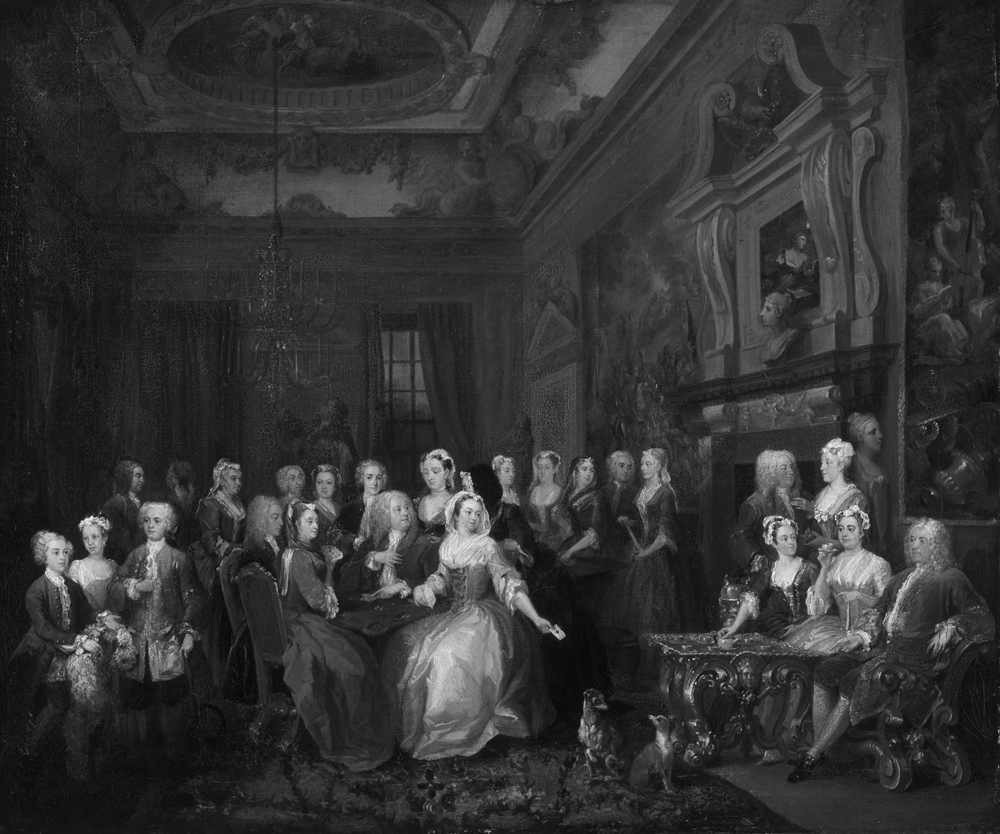
Unusual for such a popular artist many of Hogarth’s portraits remain obscure. Yet he considered his painting of Captain Thomas Coram in London’s Foundling Museum to be one of his best works. His work also includes small-scale conversation pieces, refined for the ‘middling orders’ and modest gentry.

HogarthWanstead

An Assembly at Wanstead House, 1728-31, Oil on canvas, Philadelphia Museum of Art

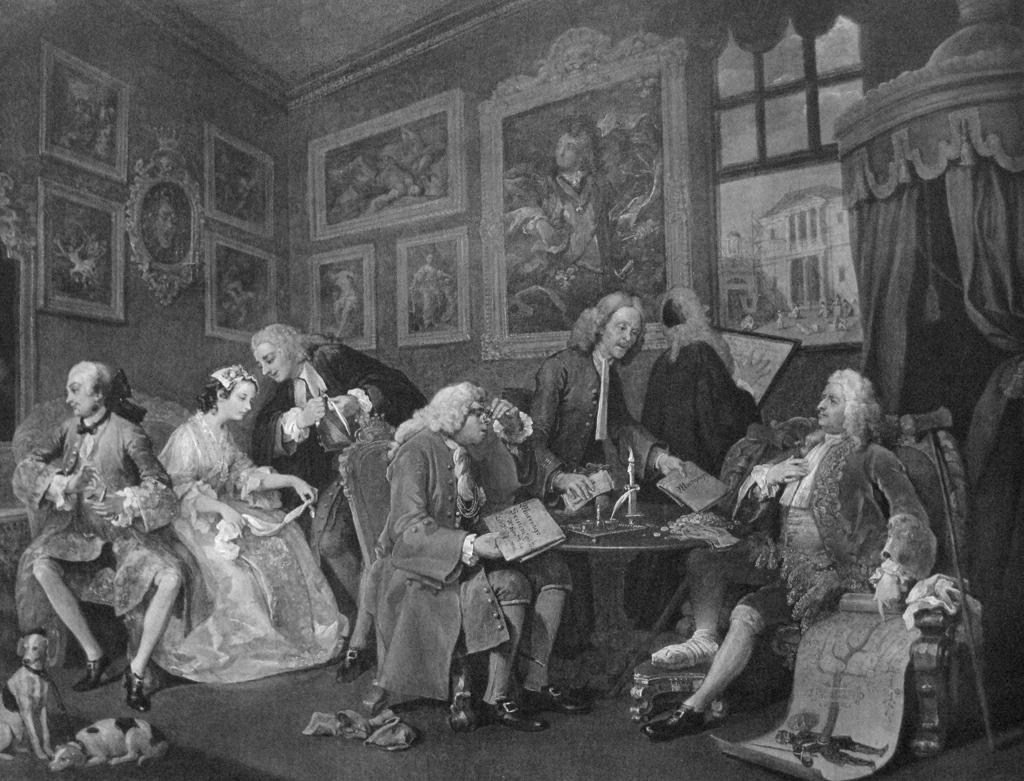
But Hogarth did not hesitate to satirise the cosmopolitan excess and dandyism emanating from across the Channel: just look at Marriage A-la-Mode; the Italianate paintings on the wall in the contract scene, and those Dutch and Flemish types in the Countess’ death scene are not there by accident. He often depicts moral corruption physically: the depraved with their syphilitic boils, commonly referred to as ‘French pox.’

hw085ch-william-hogarth_marriage-contract

Marriage A-la-Mode (Scene one: The Marriage Settlement), 1735, Oil on canvas, The National Gallery

However, Hogarth knows how to give us just the right measure of discord.  Ridicule may abound and nervous laughter from viewers continue to accompany explanations of his rake scenes but he never forgets the humanity of those he portrays.

As Architectural historian and past curator of Sir John Soane’s Museum, John Summerson said: ‘Hogarth’s people are always mimed representations of the originals – never, or rarely, caricatures. They are human beings observed as an actor might observe them and represented as an actor might represent them.’

One series of paintings, the Humours of an Election, completed more than 22 years after A Rake’s Progress, does not command anything like the same fanatical desire to view. Nonetheless, I’ve lost count of the books adorned with a scene from it printed on the cover.

Fashions aside, it could be a satire of political activities from many other times and places. That bribery took place then was well known; each parliamentary seat had a price. The parties depicted are inept and nostalgia for past achievements reigns: two men are shown recreating the 1739 naval victory of Porto Bello in Canvassing for Votes and a buckling carriage transports Britannia in The Polling.

Summerson, said of the first scene: ‘Hogarth’s ridicule is wholesale and in all the thirty-four figures there is not one which has not some degrading trait: at least, I think not one. You can have it, if you like, that the woman fiddler perched up at the back is rather an old dear – but I doubt it’.

Hogarth’s death preceded the French Revolution and the epochal change to the arts that would be brought about by Romanticism.

The motivation and inspiration behind Hogarth’s art reflect 18th century thinking. As he made clear: ‘In these compositions, those subjects that will both entertain and improve the mind bid fair to be of the greatest public utility and must, therefore, be entitled to rank in the highest class.’

Hogarth’s work features people whose frailties we can recognise if not identify with. But beyond this, his fluency in depicting human folly in its comic and tragic aspects has resonated with audiences down through the generations – his characters and their stories transcend his time and assure Hogarth’s posterity.

Hogarth: Place and Progress will be held at Sir John Soane’s Museum (October 9th 2019 – January 5th 2020)

Amedeo Modigliani

On Amedeo Modigliani (1884-1920)

By Christian Kile

‘…and all around us raged Cubism, all conquering but alien to Modigliani…’- Anna Akhmatova

‘Modigliani’s drawing is supremely elegant. He was our aristocrat. His line, sometimes so faint it seems the ghost of a line, never gets bogged down, avoiding this with the alacrity of a Siamese cat.’ – Jean Cocteau

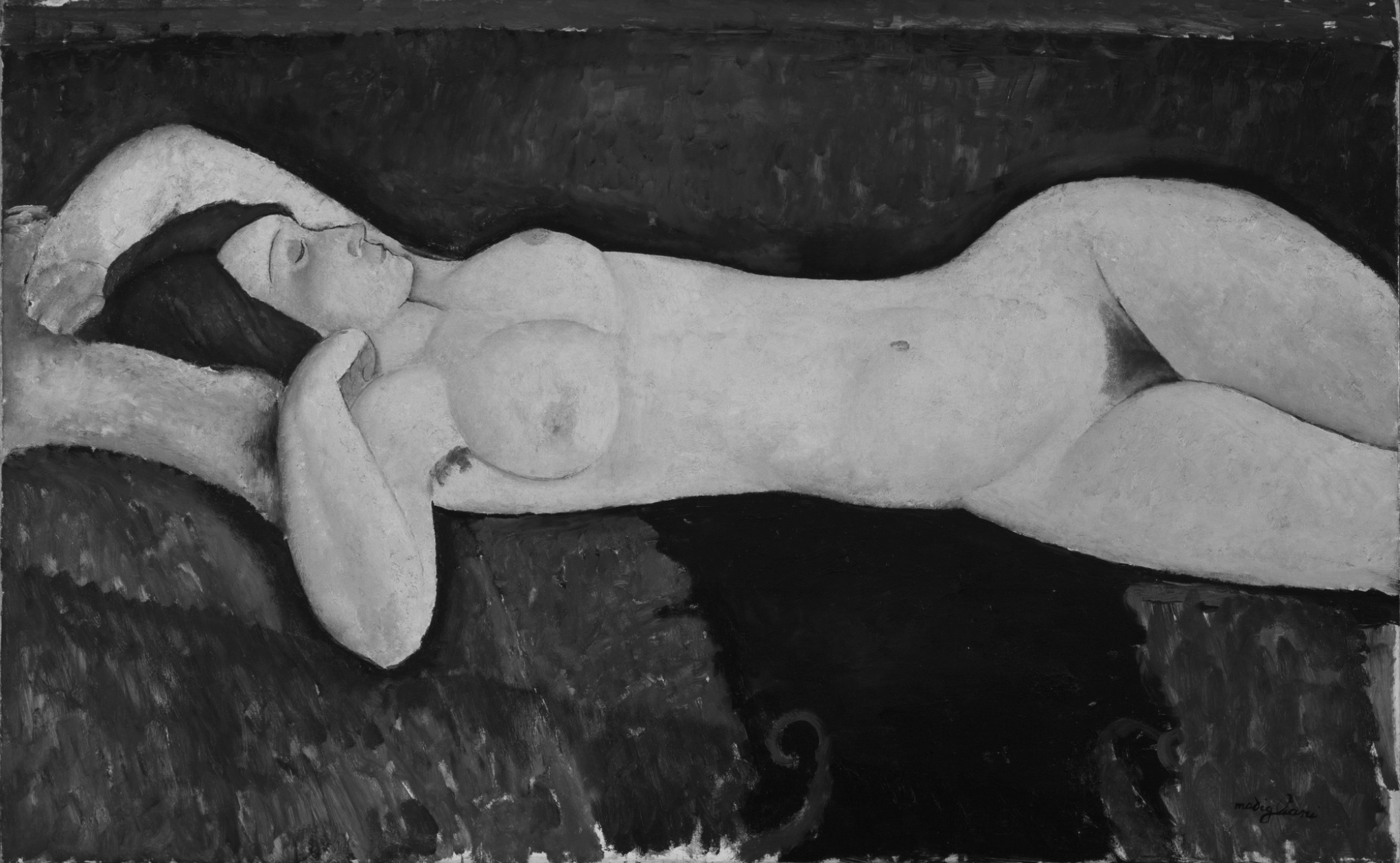
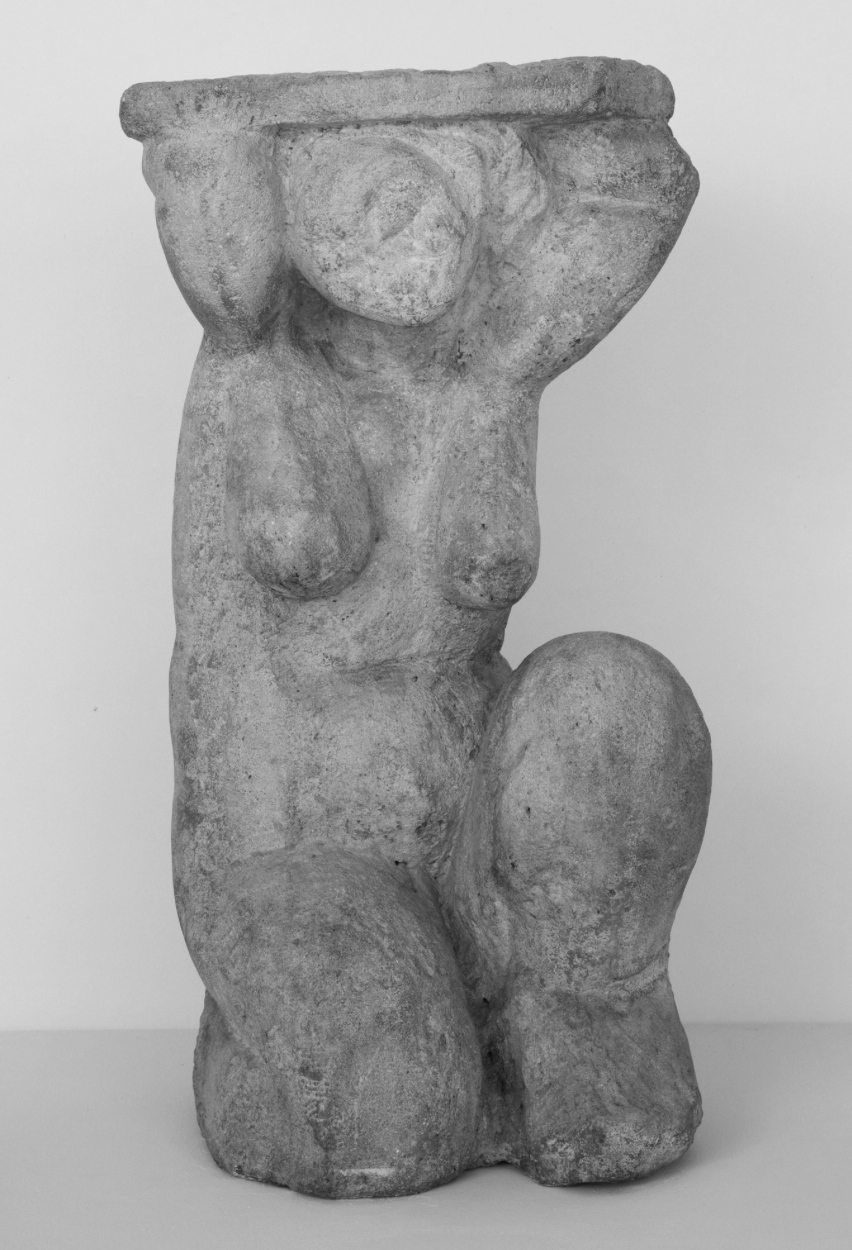
The first sculpture I saw by Amedeo Modigliani was the kneeling Caryatid (1914) in New York’s Museum of Modern Art, carved in limestone, with both arms raised and planted on one knee – a reprise from the antique. Hung beside it was a reclining nude by the same artist painted five years later, about as carnal as painting is likely to get.

nude

Reclining nude, 1919, oil on canvas, Museum of Modern Art (MoMA) – Seeing the Venus de Milo, Modigliani told his friend and muse, poet Anna Akhmatova that ‘women with beautiful figures who were worth modelling or drawing always seemed unshapely when clothed.’

They are far removed from the preoccupations and modern approaches pursued by Modigliani’s contemporaries: anxiety, the cult of the machine and Futurist rejection.

No doubt this plays a part in his immense popularity today, augmented by his life that conforms to the reckless, romantic stereotype of the artist: his appeal to women, self-destructive behaviour and early death; he died from tubercular meningitis in 1920 at the age of 35.

Modigliani is the type of artist that many people feel they ‘get’, whose work does not draw blank or bemused looks − the sense of accident and ugliness so often felt to be characteristic of modern painting and sculpture is absent.

His works are instantly recognisable, which may explain why, despite their popularity, he did not spawn a school. His stylisations are not something that can be easily absorbed by other artists into their work without seeming glaringly derivative.

Studying art was an escape for Modigliani from the maltreatment, poverty, distress, suicide and tuberculosis that plagued his family. Born in 1884 in Livorno, Tuscany, he was a young boy when his mother Eugenia Garsin said he ‘already sees himself as a painter’.

As his father Flaminio was absent for parts of his childhood, his mother was often the sole provider for the family and a dominant figure in Modigliani’s life. As the youngest child, she mollycoddled him and later accompanied him to southern Italy, and then on to Florence and Venice where Modigliani enrolled in fine arts courses.

At the beginning of the twentieth century Modigliani relocated to the town of Pietrasanta in Tuscany and, despite his lack of prior training, began to sculpt. It was a medium that he eagerly embraced. But having previously suffered from pleurisy as a youth, the quantities of dust involved in the process wreaked havoc on his already weak lungs, eventually blighting his efforts and physical and mental health.

His most prolific period for creating sculpture coincided with the zenith of Cubism in 1911-1912. This possibly explains the lack of success Modigliani had in realising his hopes for his sculptures to be incorporated into an architectural scheme.

Only one of his Caryatids, executed in limestone, is now known to exist. But his concept remains valid: one can imagine many of his works enlarged to a monumental scale and placed into an architectural arrangement.

 
caryatid

Caryatid, 1914, limestone, Museum of Modern Art (MoMA)

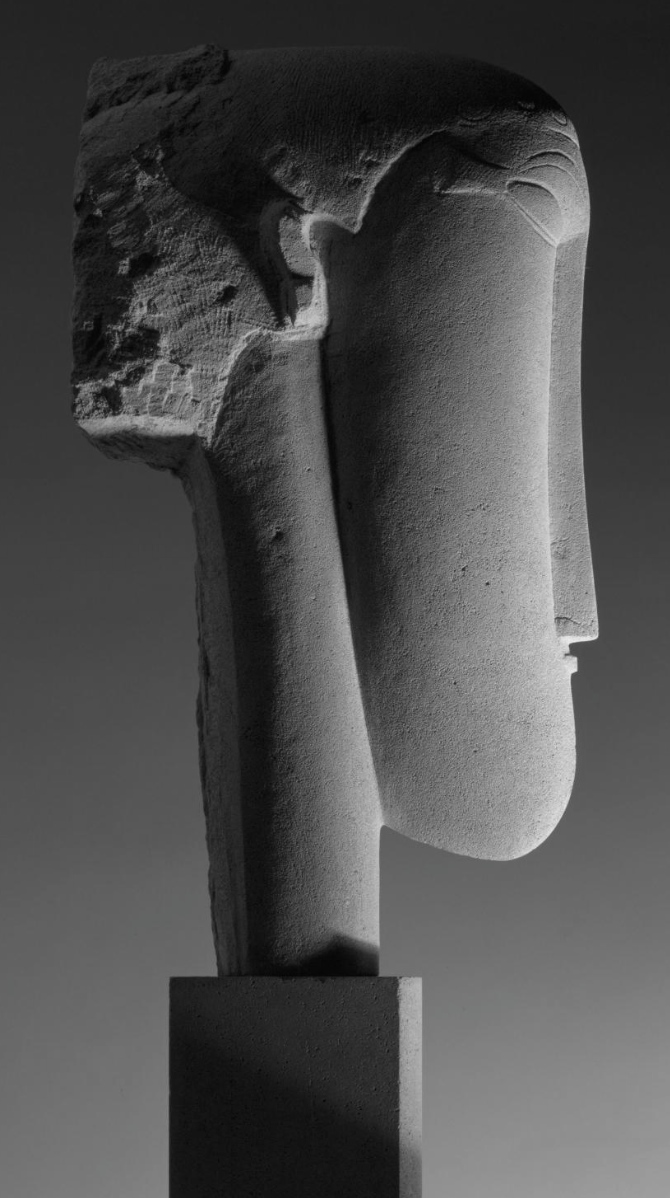
Sadly, some two figures and 23 heads are all that remain of his sculptural output, their finishes ranging from the coarse hewn to a soft lustre. The characteristic curvature of the head that eventually found its way into his paintings is already present.

At the back of these often androgynous, anonymous carved heads there are usually sections of the raw stone material.  That he did not complete most of these sculptures in the round may have been due simply to his inexperience as a carver and poor health. But perhaps keeping some of the surface of the original block was deliberate − a key signifying unrealised projects: conceived architecturally, some of his sculptures could well have been installed as corbels or keystones in a building.

For in common with other artists of the period, Modigliani dreamed of completing monumental works, his idea of a temple supported by caryatids being a prime example. A series of preparatory studies boldly reveal the breadth of his vision even if they are too impractical to have served as working drawings.

‘Heads−a decorative ensemble’, comprising seven stone heads he exhibited at the Paris ‘Salon d’Automne’ in 1912, is probably the nearest he came to attaining his grand ambition.

Screen Shot 2017-11-22 at 21.09.25

Head, 1911-12, limestone, Tate

Drawing from the influence of primitive art, prominent in Paris before the First World War, Modigliani sought to achieve an ‘archaic simplicity’. His carved heads, with expressions ranging from the inscrutable to the enigmatic, exhibit the characteristic elongated elegance with which we associate him.

Modigliani’s understanding of primitive art and its relationship to the modern were acquired in Paris. When he arrived there in 1906, Braque and Picasso were embarking on a period that was to produce some of their greatest work. But aside from a brief period in 1915-16 when Modigliani’s paintings show shades of a Cubist influence, he drew less on the art of his contemporaries than might have been expected.

Rather, at a time when the appeal of Renaissance classicism was on the wane, Modigliani chose to filter his artistic experience in Italy through the avant-garde atmosphere of Paris.

He used the Renaissance tradition of Giorgione and Titian as his foundation and was attracted by the way in which Manet, Degas and Cézanne applied this classicism to their own work. Significantly, it prompted him to develop the distinctive richness of his colours – nowhere more pronounced than in his nudes. I struggle to think of another 20th century artist who achieved such sumptuous colour.

Modigliani believed that ‘beauty’ is ‘truth’, and to capture what he perceived as the essence of his subjects he was obsessed with achieving purity of line, simplifying and discarding all excess.

Which is why the vitality of Modigliani’s drawing is never in doubt. It formed a vital part of his practice, often lightly handled and produced in great quantities. Their linear characteristic was developed early and remained ‘…a silent conversation. A dialogue between his line and ours’ observed Jean Cocteau.

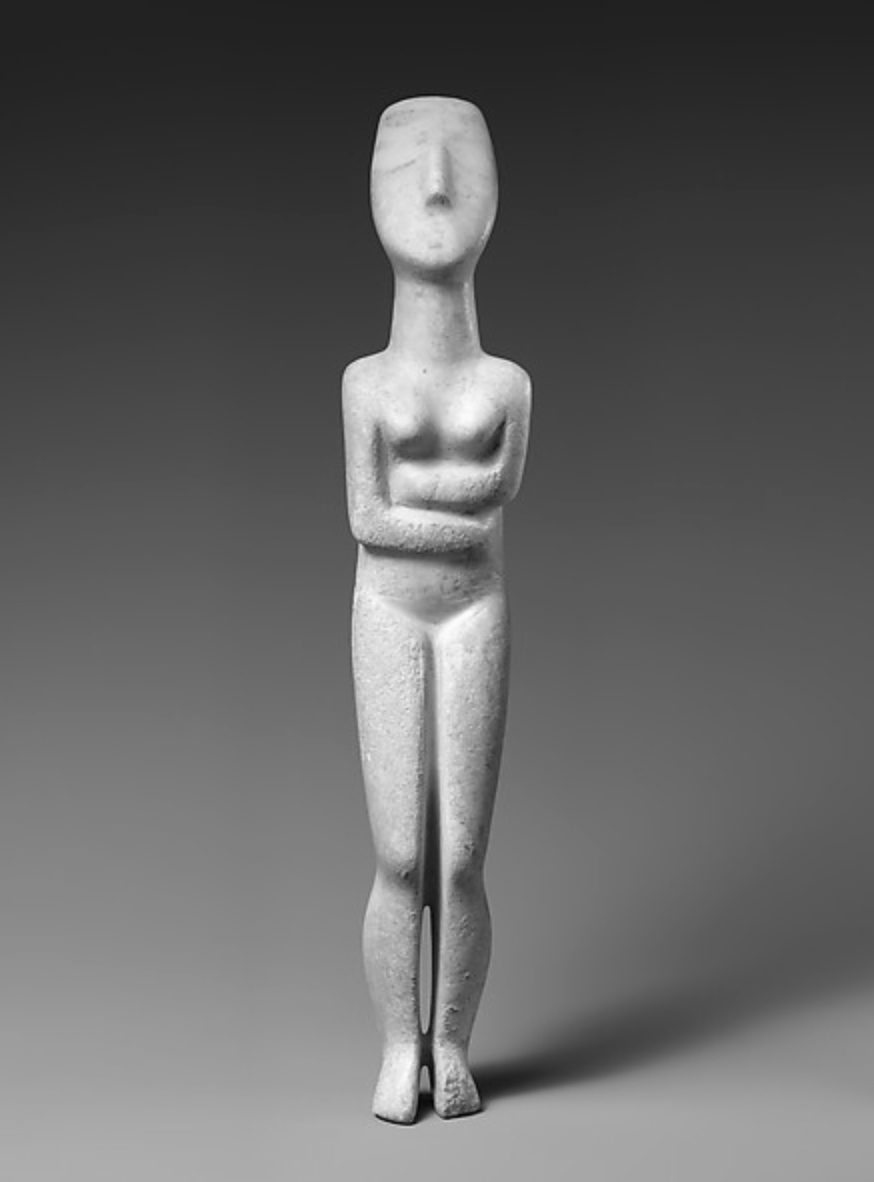
The figures and faces of classical antiquity, from the simplicity of the Cycladic art to the Egyptian goddesses spoke directly to Modigliani, as his enthusiastic visits with the Russian poet Anna Akhmatova to the Louvre indicate, and their influence can be seen in many of his compositions.

Screen Shot 2017-11-22 at 20.35.20

Cycladic female figure, 2700-2600 B.C., Marble, The Metropolitan Museum of Art

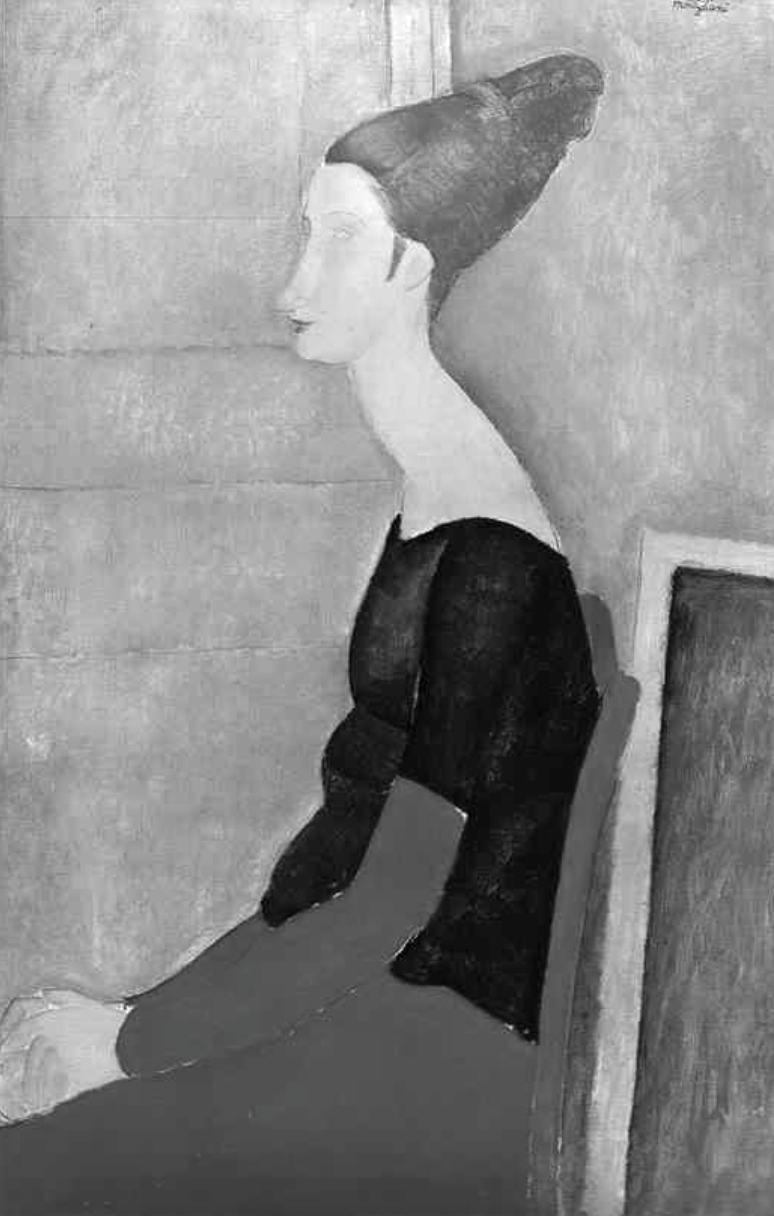
The 1918 oil of a seated Jeanne Hébuterne, with her exaggerated long neck, more serpent-like than swan, and Egyptian hairstyle, comes to mind. Then there are his ¾ length portraits of her, which, like the caryatid sculptures and other portraits, are presented with a slant of the head and sometimes blank eyes, conveying a remoteness verging on apparent obliviousness to the artist.

 
Screen Shot 2017-11-21 at 19.55.16

Jeanne Hébuterne in profile, 1918, oil on canvas, Private Collection

Modigliani achieved his greatest paintings during his final years when he was riddled with ill health and anxiety.  Always improvident – he spent money as soon as he earned it − he became increasingly despondent at the failure of his sculptural ambitions, exacerbated by his lack of patronage and the success of his contemporaries such as Brancusi and Epstein.

Nonetheless his contribution to The School of Paris was substantial. He developed a new style of reduction, simplicity and approach to colour that utilised his instincts, skill and discernment in uniting elements from a vast range of cultures.

Modigliani’s achievement is all the more impressive because he did not embrace any particular ‘ism’ or group but worked alone throughout his life to expand and develop his visionary statement of intent, made at the age of 17 years:

‘…I am trying to formulate with the greatest lucidity the truths of art and life I have discerned scattered amongst the beauties of Rome; and as their inner meaning becomes clear to me, I shall seek to reveal and re-arrange their composition. I could almost say metaphysical architecture, in order to create out of it my truth of life, beauty and art.’

 
Screen Shot 2017-11-21 at 20.23.59

Jeanne Hébuterne, 1919, oil on canvas, The Metropolitan Museum of Art – Jeanne Hébuterne, an art student, was Modigliani’s lover during the last three years of his life and mother of his child. Pregnant with their second child, she committed suicide after his death

The exhibition, Modigliani, is at Tate Modern from November 23rd 2017 until April 2nd 2018


Chaïm Soutine

On Chaïm Soutine (1893-1943)

By Christian Kile

‘The main reason I bought so many of the paintings was that they were a surprise, if not a shock, and I wanted to find out how he got that way.  Besides, I felt he was making creative use of certain traits of the work of Bosch, Tintoretto, Van Gogh, Daumier and Cézanne, and was getting new effects with colour’

Albert C. Barnes, Art Collector 1950

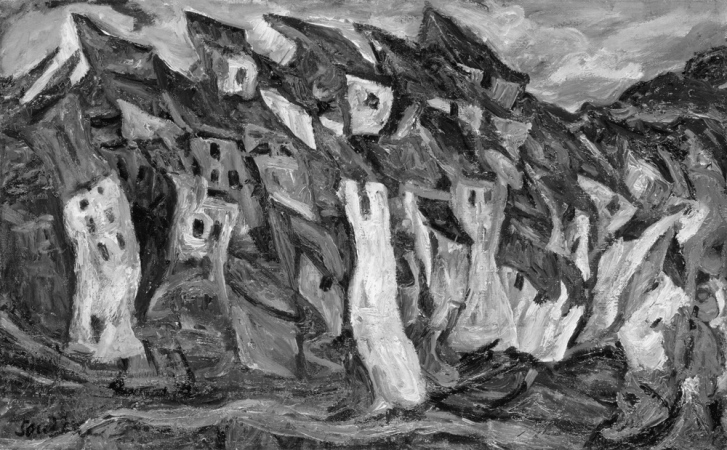
‘Houses’ (1920-21) – a group of twisting, contorted buildings pinioned between land and sky – is one of the surviving Céret landscapes painted by Chaïm Soutine. This painting, now in the Musée de l’Orangerie, Paris, shows the subjects linked and interdependent, yet, at the same time, individually competing for their space in the landscape.

“This would be unbearable on acid”, said one of my friends on his first visit to the museum’s Soutine rooms.  And his work does have a hallucinogenic quality.

Soutine is an artist who destroyed to create, willing to slash and burn his paintings to ashes, keeping only the versions he liked, a process that has resulted in infusing them with an unsettling intensity.

houses

‘Houses’, 1920-21, oil on canvas, Musée de l’Orangerie

But consciously or not, this painter of swooping churning anguish reigned himself in and probably saved his sanity with the use of restraining external influences.  He played Bach, the most ordered mathematically precise composer, when he painted; he adapted his primal social behaviour in the company of his highly-cultured patrons, the Castaings, and throughout his career he reworked the old masters, respectful and always mindful of their discipline.

Soutine was stirred by the work of Rembrandt whom he revered, and was particularly fascinated by his idol’s depiction of flesh, returning to an interpretation of the Louvre meat carcass more than once.  His one-time neighbour, the writer Henry Miller described his preoccupation with flesh as an obsession.

The way in which many of Soutine’s images produce an effect of life in death, notably the poultry and bulkier carcasses – mouths, beaks and eyes open wide – make us feel we have just missed the slaughter and that only moments ago these were living creatures.

Indeed, Soutine’s carcasses seem more alive than many painters’ live subjects. Adjust the canvas by 90 degrees and his ‘Hare Against Green Shutter’ (1925-26) would be seen to be loping along!

Soutine worked in spates, not painting for days, weeks or even months, and then would set to with a ferocious intensity, often for many hours at a time.  The decomposing animal carcasses sometimes had to be infused with formaldehyde to dull their stench.

It was testing for his sitters, even verging on cruelty.  Determined to see through their surface appearance, Soutine subjected them to long days and weeks of concentrated and sustained looking followed by furious action. One of his models tells of being made to pose for so long that it verged on a hallucinatory experience for both of them.

While no group claimed him, Soutine is classed as an Expressionist. Essentially though, his art is his direct response to confronting nature, and his trademark intensity is probably due to his working in isolation in France, away from the influence of the Expressionist group of artists based in Berlin, Munich or Vienna.

Soutine was not one for words.  He neither kept diaries nor written correspondence about his work, and whether he made preparatory drawings remains contested.  If he did, then like many of his canvasses, he probably destroyed them.  What remains is a small collection of photos taken throughout his life and the paintings.

still life

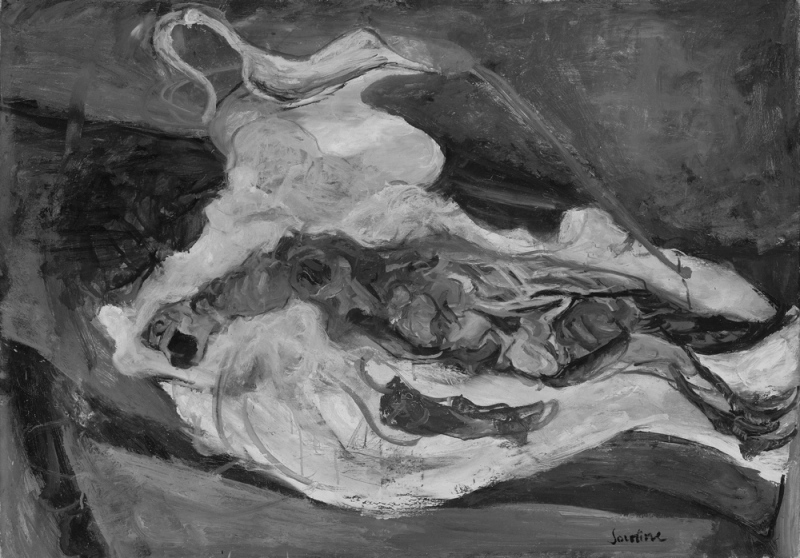
‘Still Life with a Pheasant, circa 1924, oil on canvas, Musée de l’Orangerie

Soutine grew up in the small, poverty-stricken Jewish village of Smilovitchi, Belarus.  His father, a strict disciplinarian and devout Jew, discouraged him from pursuing his interest in art for which he had shown a marked talent from an early age.

Despite much opposition, he eventually moved to Minsk and embarked on a drawing course, followed by three years at the Vilna Academy of Art in Lithuania. Afterwards in 1913 Soutine moved to Paris to further his career.  He was alone for much of the time and poor but he allowed nothing to get in the way of painting.

Here, through the artist Jacques Lipchitz, he met Amedeo Modigliani. Theirs was a close if tempestuous friendship – aggravated by heavy drinking – despite their radically different temperaments and work styles.

They were a familiar sight on the town.  Modigliani drew out Soutine socially; he complimented him and encouraged him in his work, and his premature death deeply affected Soutine.  Alcohol was blamed and from then on Soutine limited his drinking.

Through Modigliani Soutine was introduced to art dealer Leopold Zborowski, who represented him from 1917 to his death in 1932.  He also benefited financially from the arrival of Dr. Albert Barnes, an American businessman, in Paris in 1922.

A discerning collector, intent on buying paintings for his Philadelphia Art Foundation, Barnes swiftly saw the quality of Soutine’s works: delighted by the painting of pastry cook Rémy Zocchetto, he bought the series of below stairs hotel and kitchen staff portraits* by the artist.  Barnes acquired some 52 paintings, maybe more, that have contributed substantially to Soutine’s posthumous success and recognition.

The artist’s fortunes continued to look up when he met Marcellin and Madeleine Castaing in the late 1920s.  Two of the most influential figures in his career, they became his patrons and supported him for the rest of his life.  For ten years Soutine was invited to stay and work at their pastoral retreat at Lèves.

Madeleine was a successful interior designer and her circle included cultured members of the French establishment, bringing Soutine into contact with leading lights such as Cocteau and Satie, and art historian Elie Faure, who became an enthusiastic champion of his work.

If he personally seemed one step away from self-destruct, many of his paintings were not spared.  We are lucky that any of his Céret landscapes survive.  Faure said of them: “In his studio, he lacerates them with rage.”

An impoverished Soutine spent time in Céret, a town in the Pyrenees, between 1919-1922, where he was unable to get on with other artists and locals.

Nonetheless, this period resulted in a series of his most distinctive and bacchanalian paintings.  Here, figures, landscapes and buildings are compressed, distorted and thrust towards the viewer on claustrophobic canvasses.

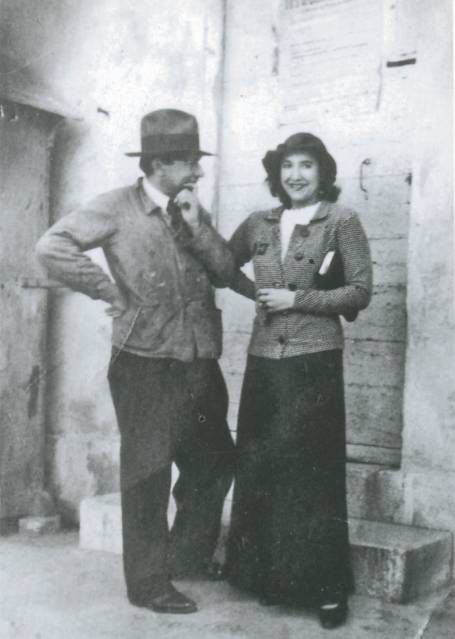
Madeleine Castaing recalls: “While he was painting, everyone … had to disappear.  We always waited in fear of that sinister noise.  If he didn’t like the painting, he’d take a knife and slash it…Then he had to like the painting when it was finished…He would call us to come and see it…If he saw the smallest trace of disappointment, he would grab the gasoline which he had next to him and a sponge…”

photo

Soutine and Madeleine Castaing during the mid 1930s

Perhaps Soutine believed that his later work surpassed the Céret paintings that might have signalled a dead end – that is, he felt he could go no further in this artistic direction without straying too far into abstraction.  Or, perhaps, they were simply a reminder of a difficult period he would prefer to forget.

Soutine’s late period is generally considered to be from the mid-1930s to 1943. Some critics and writers have dismissed these works as regressive. He is accused of needlessly reining himself in and being so enthralled by past masters that it reduced the urgency and potency found in the earlier paintings.

Regardless of the reduced pictorial aggression—allowing the faces in his portraits to be averted, ridding them of their dramatic confrontational stares found in the earlier works, and producing landscapes that are more classically formal in structure—Soutine’s vision, energies and painting process in these late works remain consistent.

The images– landscapes, portraits, still-lives – are a natural progression from the artist’s earlier ones and reflect the artist’s dedication, throughout his career, to achieve ever-increasing clarity and concentrated expression.

Unfortunately, assessment of Soutine’s late paintings is hampered by the lack of them on public show (many are in private collections) and that they are disproportionately few in comparison with his earlier works; 100 paintings are known dating from the 1930s onwards, compared to 400 painted in the preceding 15 years. And that does not include the early paintings he destroyed!

During this latter part of his life and despite his notorious unsociability Soutine sustained close relationships with women.  He met Gerda Michaelis, a Jew from a prosperous family, who had fled Nazi Germany to live in Paris, where she was working as a house cleaner.  Gerda kept his studio and apartment clean and orderly, and helped him seek treatment for his crippling stomach pains.  They separated in 1940 at the onset of the Second World War.  Gerda survived but never saw Soutine again.

In November 1940 Soutine met Marie-Berthe Aurenche, recently divorced from the Surrealist Max Ernst.  With the Nazi threat looming she and her friends helped Soutine escape from Paris and he took refuge near Richelieu.

But the constant worry of living as a fugitive aggravated his stomach illness, and he was forced to return to Paris for urgent treatment.  After a treacherous journey into the city Soutine underwent an operation for his ulcer but he died soon afterwards on August 9th 1943.

Soutine was buried at Montparnasse Cemetery, the service attended by a small group of artists and friends, including Aurenche, Picasso and Cocteau.

Although Soutine cannot be described as an under appreciated artist internationally, he certainly has been overlooked in the UK.  Fashion and poor critical opinion have seen to this.  So this is a rare opportunity to see a collection of his portraiture.

portrait

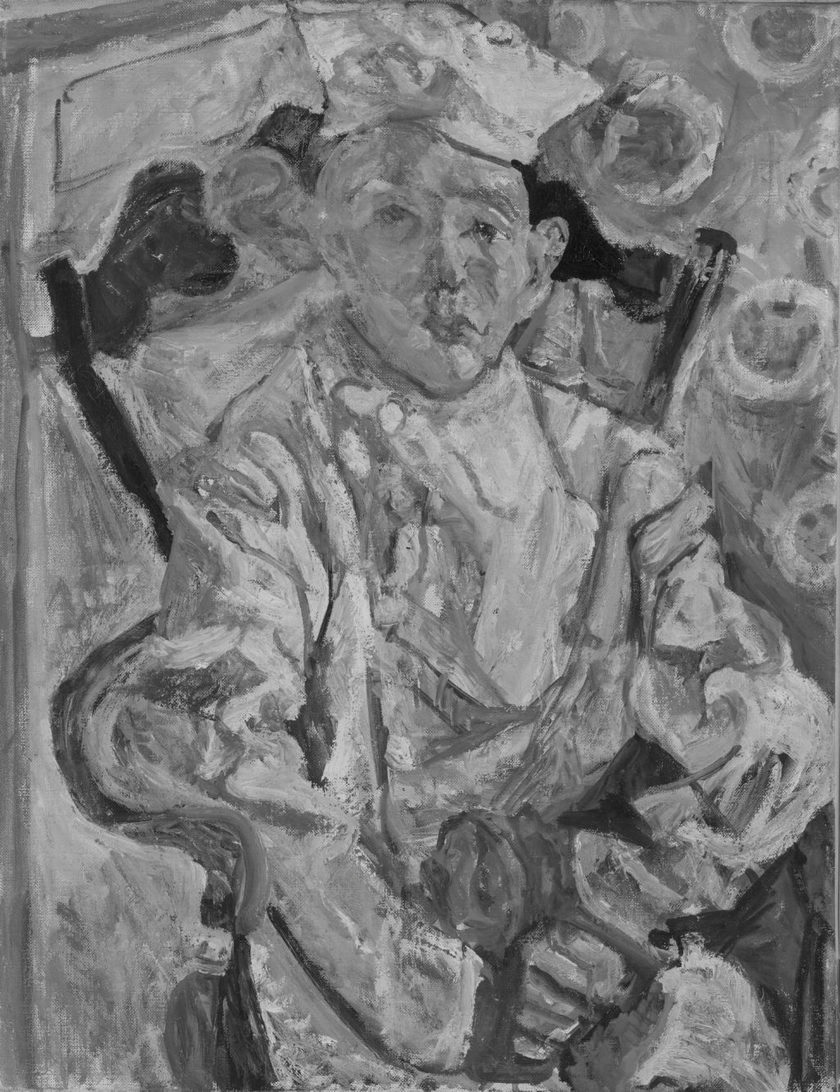
The Pastry Chef (Baker Boy) (Le Pâtissier), c. 1919, oil on canvas, The Barnes Foundation

The upcoming exhibition, Soutine’s Portraits: Cooks, Waiters and Bellboys*, is at The Courtauld Gallery (October 19th 2017- January 21st 2018)


Jean-Michel Basquiat

by Christian Kile

‘Following the fashionable lead of his time (epitomized by the Prince of Wales) he dissipated his talents and his life (1763-1804). Debts forced up his output – during the last eight years of his life he produced at least 100 canvasses a year; whilst drink and false stimulation of every sort made his work even more automatic and repetitive than it might otherwise have been.’

The above is quoted from John Berger’s essay on the Georgian artist George Morland, renowned for his prolific output and problems with dealers, and it could well be applied to the life of Jean-Michel Basquiat.

More often than not, when I hear Basquiat’s name mentioned it is in relation to the sensational aspects of his life rather than his work: his relations with Andy Warhol and Madonna, the exorbitant praise from dealers and hangers on, the brief period of success, followed by the collapse into drug addiction and death. He personified the excesses of the 1980s New York art scene. Which makes Basquiat all the more appealing to dealers and the star struck. And today his prices continue to soar.

It has been almost 30 years since his death and the hype shows no signs of abating. He first gained attention in the downtown New York scene of the late 70s and early 80s with graffiti that was markedly different from his contemporaries. It involved more than tagging a name; more singular, Basquiat’s graffiti was littered with witty words or symbols – and there were plenty of them – that later found their way into his drawings and paintings.

During my last visit to the Whitney Museum, his work, ‘Hollywood Africans’ attracted crowds of visitors, dominated by those in their late teens and 20s, who appeared fascinated by his life and times and 1980s fashion, and full of admiration for his work that clearly struck a chord.

He achieved success quickly in his career and his output was sizeable. His early and late styles concertinaed within a decade and by 27 he was dead. He worked intuitively, drawing from a vast pool of stimulus: such as Dubuffet, Twombly; Picasso and Rauschenberg without the eroticism; television and radio; his experience as a young black man, and eclectic musical influences, including classical and jazz.

This is the first time a substantial Basquiat show has been held in the UK. Perhaps even now insufficient time has passed to override those critics determined to view his work as a symbol for the degradation of art history and the triumph of the art market over works of quality.

However, he is original enough to figure in the canon of art history, and for good reason. He was able to spell out and successfully communicate to us what he, young and black, perceived in the world around him and within himself through his work.

It seems to me that he is one of the last significant 20th century artists capable of creating good paintings, which hang in major museums and galleries, and will continue to do so. I do not find a Basquiat painting in New York’s Museum of Modern Art out of place.

Nonetheless, it is clear that much of his popularity is down to fashion and the market. That he emerged from a graffiti background is significant – it helped him to attract and connect with his public, whom he later secured in his transition to painting.

It could also legitimately be argued that in some quarters his contribution is overestimated, particularly if we compare him to another 20th century artist who too died early: Egon Schiele far and away surpassed him as draughtsman and painter, and his work possessed great psychological depth.

But while Basquiat may not be the genius some claim, it is also true that the financial success he enjoyed in his lifetime and excessive commercialism surrounding his work should not be used to discredit and dismiss his artistic achievements. If exploitative dealers, hangers on and drugs had not dragged him down, there is every chance his work would have continued to develop well and matured.

For now we can count ourselves fortunate to see such a comprehensive exhibition of his works in this country – it’s been a long time coming.

Glenn

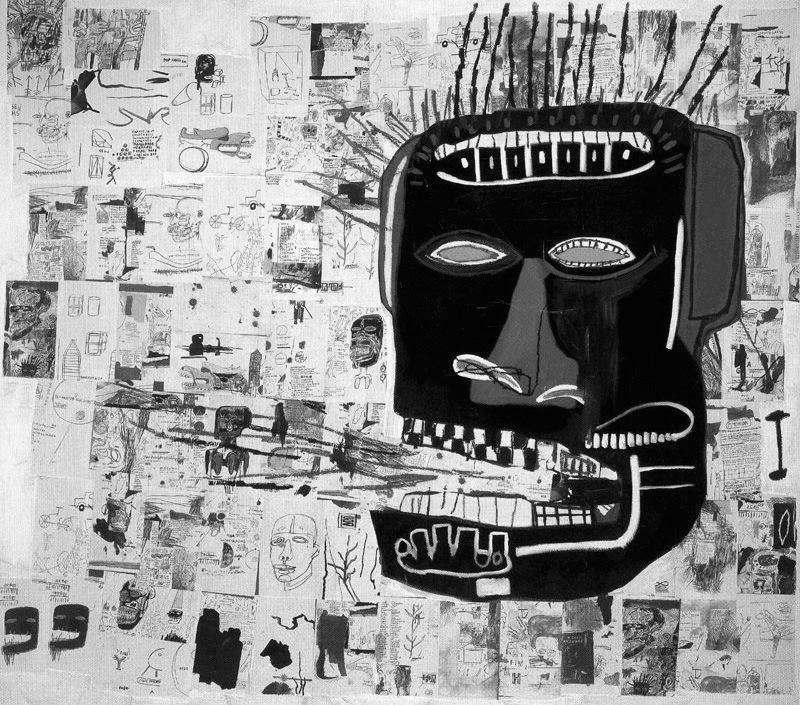
Jean-Michel Basquiat, Glenn 1984/5


Basquiat: Boom for Real 

The Barbican, London (21 September 2017 – 28 January 2018)