Gwen John: Art and Life in London and Paris at Pallant House Gallery 13 May – 8 October 2023

By Christian Kile

https://newcriterion.com/blogs/dispatch/tone-poems

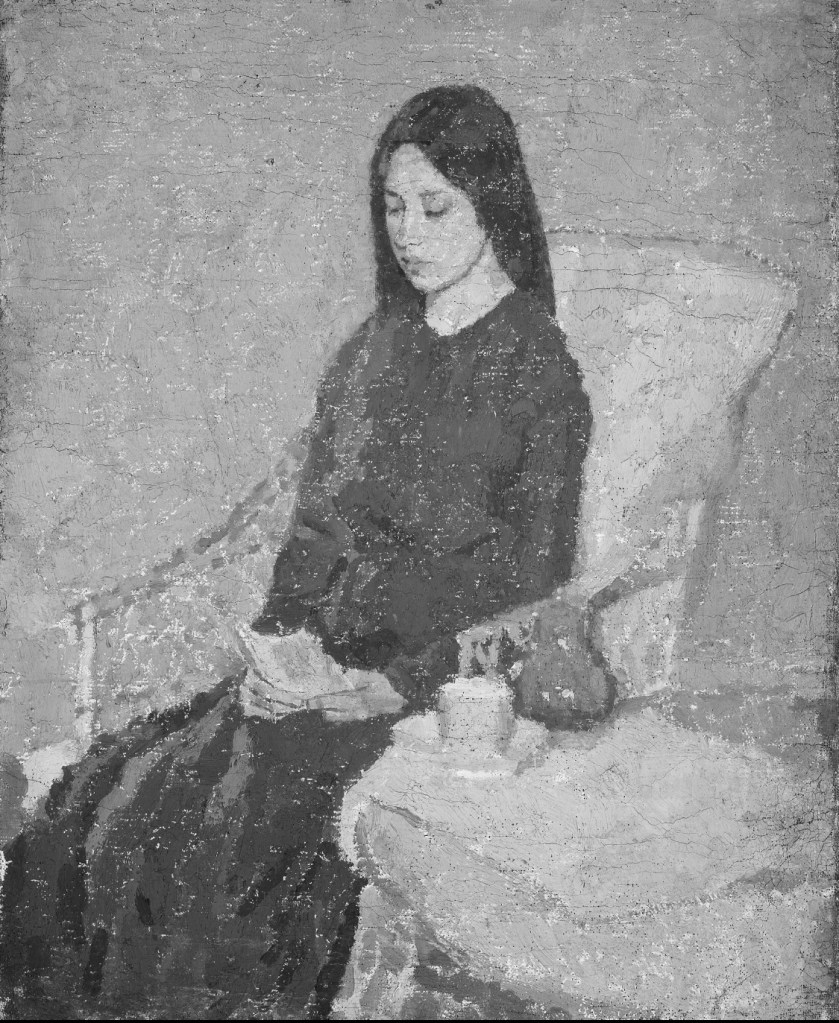
Gwen John, The Seated Woman (The Convalescent), c.1910–20. Oil on canvas. Ferens Art Gallery: Hull Museums

The essence of Gwen John’s art is summed up by her teacher James Abbott McNeill Whistler: tone. When her brother Augustus John talked about the character of her work, Whistler fired back, “Character? What’s that? It’s tone that matters. Your sister has a fine sense of tone.”

Whistler touched on something important. Gwen John’s penchant for more analytical methods, frequently returning to the same subjects, often emphasizing formal elements and with subtle variations, helps explain what makes her work so striking. Her paintings can convey a notion of “impersonality” or purity, a vital strand of modernism, more Continental in nature and closer to the maelstrom that came with the demolition of humanist optimism in the twentieth century.

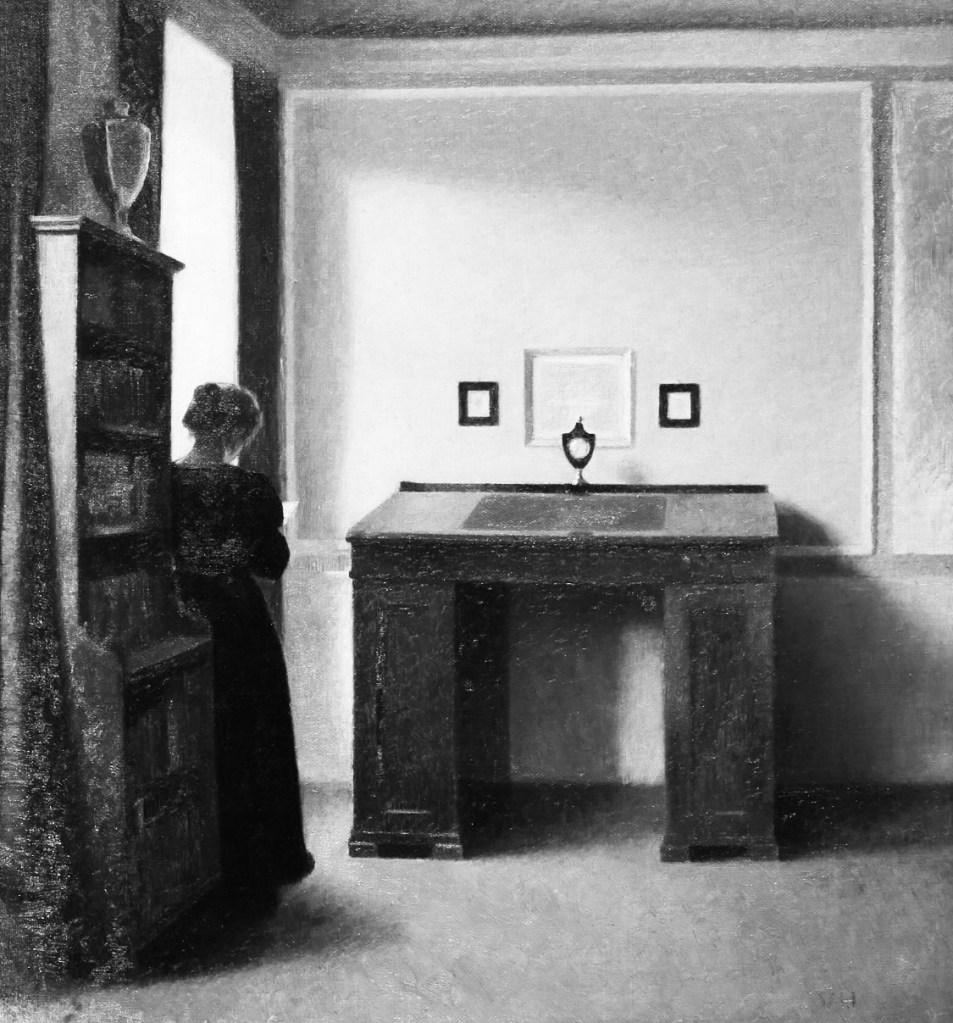
Gwen John, A Corner of the Artist’s Room in Paris, c.1907–1909. Oil on canvas. Sheffield Museums Trust
Vilhelm Hammershøi, Interior with Writing Table and a Young Woman, 1900, oil on canvas, private collection

Drawing and painting were a habit from her early years, and the strength of her draftsmanship is on display from the first room in a new exhibition at Pallant House Gallery, “Gwen John: Art and Life in London and Paris.” This is the first major showing of John’s work in twenty years, with oils, works on paper, archival material, and personal possessions. The full course of her career is traced chronologically, and the exhibition includes a select group of works from her contemporaries. In the second room, Vuillard and a marvelous Hammershøi hang close by a selection of John’s interiors. In one corner there is a small-scale plaster head by Rodin, Head of Whistler’s Muse (ca. 1906), a monument to Whistler for which John modeled.

As the show progresses there is in John’s work an increasing economy of style: whether still life, portrait, or interior scene, images tend to be expressed with a more muted palette; colors lighten, diffusing into patches with little voids of finely primed canvas emerging through strokes of oil paint. Society figures are absent. Often subjects are anonymous female sitters positioned within a sparse studio interior as in The Convalescent (ca. 1923–24), The Seated Woman (ca. 1910–20), and Girl in a Mulberry Dress (ca. 1923).

Many compositions are repetitive in John’s drawings and paintings, sometimes highly so—the variations between images, often portraits, remain within a particularly narrow range. Seeing these works as reproductions does them few favors but viewing the originals hanging together, the nuances of the paintings achieve a satisfying effect, notably in one room where they sit comfortably opposite Cézanne’s oil painting Head of a Boy (1881–82).
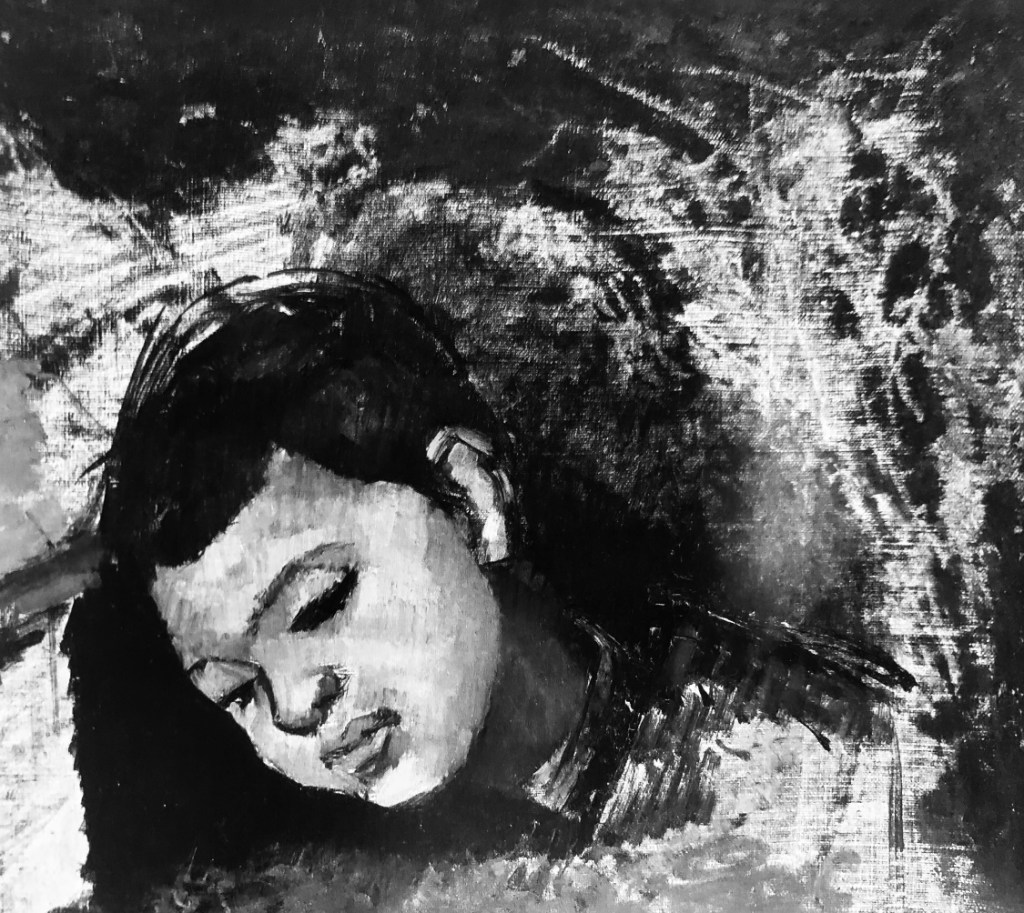
Paul Cézanne, Head of a Boy, 1881–2, oil on canvas, private collection
Gwen John, The Convalescent, c. 1923–4, oil on canvas, The Syndics of the Fitzwilliam Museum, University of Cambridge

“It is not unreasonable in Paris,” Paul Valéry observed, “to disguise what one has which is substantial and painfully acquired, under a lightness and grace which serve as a protection for the secret virtues of attentive and studied thought.” John’s art is often an embodiment of this insight. Despite her modest background, she established herself as an artist, becoming a recognized and respected figure in Paris during its modernist high tide. Following schooling at London’s Slade School of Fine Art, and further tuition under Whistler, she moved to France for good, living between the capital and its suburb of Meudon.

There on the continent, John found herself at a fountainhead of European modernism and became acquainted with many of its foremost figures: Picasso and Matisse, Braque and Wyndham Lewis, Brancusi and the poets Pound and Rilke. She became Rodin’s model and lover. It was a troubled affair, but, despite this he, like many others, esteemed her art.

This show does well to avoid focusing too much on John’s personal life as a means to understanding her art, rightly placing emphasis on her work. The once-overriding image of her as a recluse, apart from the avant-garde and intellectual currents of her time, is long gone. Given the marked increased focus on female artists in recent years, it’s surprising a figure this consistent has waited until now for a show of this standard.

The American lawyer and art collector John Quinn, an eminent enthusiast of John’s work, provided robust support, his period of patronage coinciding with her most prolific years as an artist (1910–24). He helped persuade John to part with her work as well as providing opportunities for her during wartime privations. Quinn said, “If I had to make a choice between the painting by you . . . and the Picasso, I should cheerfully sacrifice the Picasso.” Sometimes a little money and admiration are all that’s needed for encouragement.

During John’s final decade, her artistic pursuits apparently dwindled, and, due in part to illness, she became increasingly aloof and reclusive. Her work, however, remained desirable, and her family continued to offer support. The Brittany and Normandy coastlines were her retreat, and during a last visit to the sea she died in Dieppe at age sixty-three.

One leaves the show feeling John remains an underappreciated figure; putting this down entirely to her sex is unconvincing, for other twentieth-century female artists have gained much more notice. Without political diversions or manifestos, she knew her works were significant, and labored hard for them; perhaps she thought the personal cost too much and stopped her production early. Regardless of the cause, her self-imposed exile from the London scene and turn to Catholicism contributed to a body of work with an understated quietude. She reflected that for her, art came before children; who, she said, is remembered by history simply for becoming a mother?
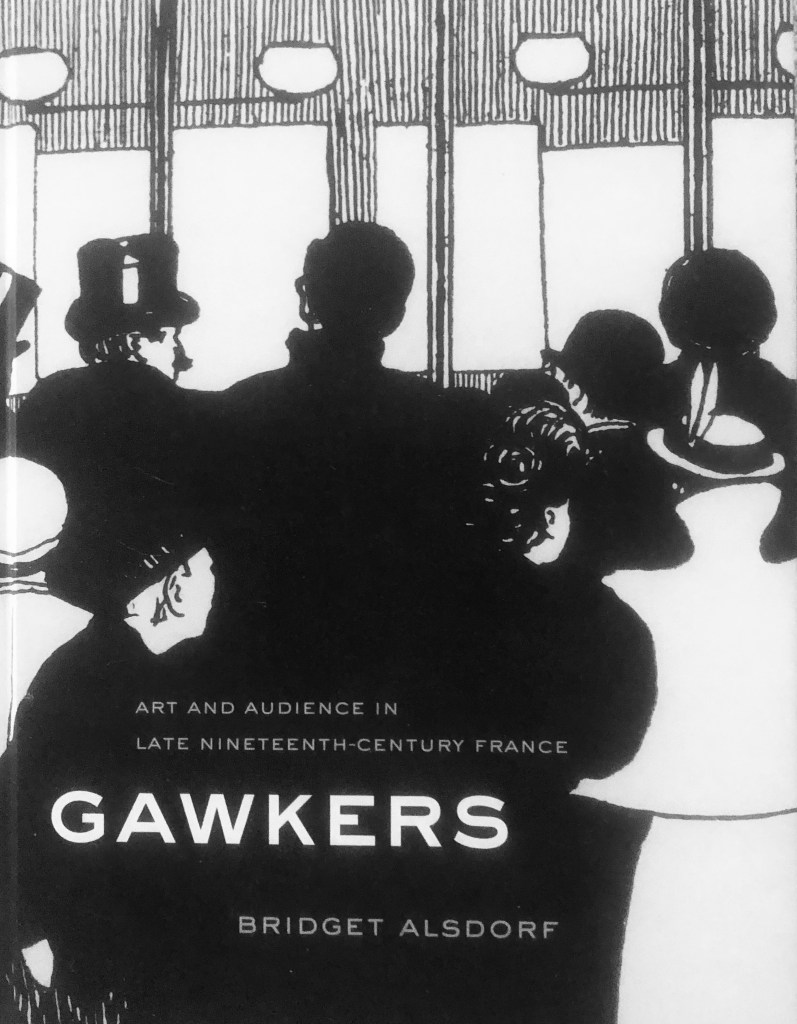
Review of Bridget Alsdorf’s ‘Gawkers: Art and Audience in Late Nineteenth-Century France’

By Christian Kile

http://www.sehepunkte.de/2022/04/36548.html

Unlike the detached sophistication and individuality of the flâneur, badauds or gawkers, the impulsive and often fickle members of a crowd are prone to distraction and often impressionable, taking part in the urban theatrical spectacle for reasons of curiosity through to cruelty. The term “badaud” is said to originate from the work of François Rabelais in a disparaging account describing Parisians as “so stupid, so gawking, and so inherently inept”, but by the nineteenth century this term had expanded to encompass those in the streets searching out forms of amusement, entertainment or reasons to gossip (3).

Gawkers are present throughout the social spectrum and, according to Bridget Alsdorf, nowhere else are they better expressed in the visual arts than in the early work of Félix Vallotton: it is here that gawking urban spectators are most sharply captured and it is his fascination with the crowd that is the context in which the other artists in this book are considered. The four chapters of Gawkers are arranged by theme: “Accident” examines the mishaps of street life, “Audience” takes the theatre and theatricality as a distinctive element of the urban world, “Street Theater” observes the mostly outdoor theatrical aspect of the city, whilst “Attraction” centres on the bond between public, advertising and goods, together with their effect on artists.

Despite a lack of written records on Vallotton’s political stance, it is known that his intellectual milieu was, on the whole, “far left” and in 1902 he directed his criticism towards “the police, the judiciary, banks, commerce, education, religion, and even parents” in a series of lithographs for the anarchist/socialist journal L’Assiette au beurre (2/47). In these prints troubles can simply arise from a chance encounter; by being a mere bystander the gawker becomes implicated and to a degree responsible for the scene unfolding before him. For public executions, France remained “the only nation in Western Europe still performing them at the fin-de-siècle” (53).

Gawkers, Parisians in particular, did not escape the scorn of the intelligentsia; Gustave Flaubert, Léon Daudet and Eugène-Emmanuel Viollet-le-Duc were exceptionally acerbic. Crowds drove Stéphane Mallarmé to experiment in his work, prompting him to attend a symphony for no other reason than “badauderie”, causing him to shift his focus from stage performances to “sniff out the occasion” in the bustling crowd (14). With the expansion of urban life and development of mass culture artists had to compete with and overcome the increased distractions of their public; this, at a time when experimentation with emerging forms of photography and film were impacting on more traditional methods.

Honoré Daumier makes an appearance too, markedly documenting theatre life from many spheres in the 1850s and 1860s. Hundreds of his caricatures made it to the press, exposing the “mundane interpersonal conflicts, petty squabbles, and financial pressures” of the Parisian scene, both backstage and in the auditorium (81). With the blending of fine and popular arts, his work moved into the hinterland between mere entertainment and art considered suitable for connoisseurship.

In Edgar Degas’ works the split between stage and an often indifferent and inattentive audience is emphasised. Most of his performance images “do not include even a glimpse of people watching the show” and when they do they tend to be men with stage side benefits (93). In Vallotton’s theatre scenes of the 1890s the draw of the audience resulted in his abandoning the stage as a focal point altogether, documenting the dispiriting behaviour, ranging from “jingoistic fervor” to “apathetic withdrawal” (107).

The spontaneity and surprises of the street as theatre are explored in Pierre Bonnard’s early and more neglected paintings, prints and sketches. Although Bonnard enthusiastically took to photography about this time, he shied away from street scenes – his shots were mainly of his circle in more pastoral settings and interiors. In order to show how Bonnard’s wandering eye allowed him “to show how he represents badauderie as both fleeting and sustained”, Alsdorf contrasts his work with “the fixed gaze of early French cinematography”, enabling exponents such as the Lumière brothers to play on the curiosity of urban gawkers, recording either staged activity or the genuine surprise of undirected crowds, struck by the experience of being filmed (121).

The relationship between gawkers, art and the explicitly commercial world of advertising (from posters to the department store) is explored through the works of Bonnard, Vallotton and Henri de Toulouse-Lautrec. The quandary remained: how to gain and maintain the attention of the public without debasing one’s work. The distinction between art and shopping was becoming increasingly blurred. Rival outlets, Le Bon Marché and Les Grands Magasins du Louvre installed in-house galleries of fine art: “breasts were as ubiquitous in advertisements as in ancient sculpture, and the storefront vitrines […] were akin to display cases in museums” (180).

Aside from uniting two main genres of his early work, crowd and interior, Vallotton’s secular triptych, Le Bon Marché is given a close reading by Alsdorf and presents us with a paradigm of nineteenth century consumption: the department store, complete with its many devices for driving acquisitive desires, the world where “everything and everyone is for sale” (210). These values were not confined to Vallotton’s work. Whilst painting the triptych he was contemplating a split with his seamstress partner, whom he eventually left for an affluent widow of an art dealing family.

The artists and intellectuals featured in Gawkers often have in common a persistent, amorphous and fraught relationship with the wider public. The issue becomes still more complex when many of them periodically become part of the crowd themselves. On one hand, their feelings veer from outrage at state corruption and its consequences for the masses, and on the other, a snobbery and contempt at their ignorance. At the same time, if they are to establish themselves and secure a place in history, they have to acknowledge that the crowd is an important factor, as both subject and client.

As one might expect in a book concerned with the late nineteenth century, the “bourgeois” pervades: there is “bourgeois morality”, a “bourgeois interior”, a “bourgeois accessory”, a “bourgeois trophy”, “bourgeois amateurs” and a “bourgeois elite” (215/216/218/221/226). It goes on. However, it is not clearly defined. Does it straightforwardly refer to the perceived materialistic values or conventional attitudes of the middle class, or is it a general derisory term for the enemy? Perhaps all of these.

A great deal of ground is covered in Gawkers; in-depth descriptions of artworks, politics, anarchism, the many conflicts between the artist and society, from Oscar Wilde’s trial to the rupture of the Dreyfus affair. This, combined with the prominence given to Vallotton, an artist who until relatively recently was marginally underrated helps make for a lively addition to the vast literature on nineteenth century French art history.