Gwen John: Art and Life in London and Paris at Pallant House Gallery 13 May – 8 October 2023

By Christian Kile

https://newcriterion.com/blogs/dispatch/tone-poems

Gwen John, The Seated Woman (The Convalescent), c.1910–20. Oil on canvas. Ferens Art Gallery: Hull Museums

The essence of Gwen John’s art is summed up by her teacher James Abbott McNeill Whistler: tone. When her brother Augustus John talked about the character of her work, Whistler fired back, “Character? What’s that? It’s tone that matters. Your sister has a fine sense of tone.”

Whistler touched on something important. Gwen John’s penchant for more analytical methods, frequently returning to the same subjects, often emphasizing formal elements and with subtle variations, helps explain what makes her work so striking. Her paintings can convey a notion of “impersonality” or purity, a vital strand of modernism, more Continental in nature and closer to the maelstrom that came with the demolition of humanist optimism in the twentieth century.

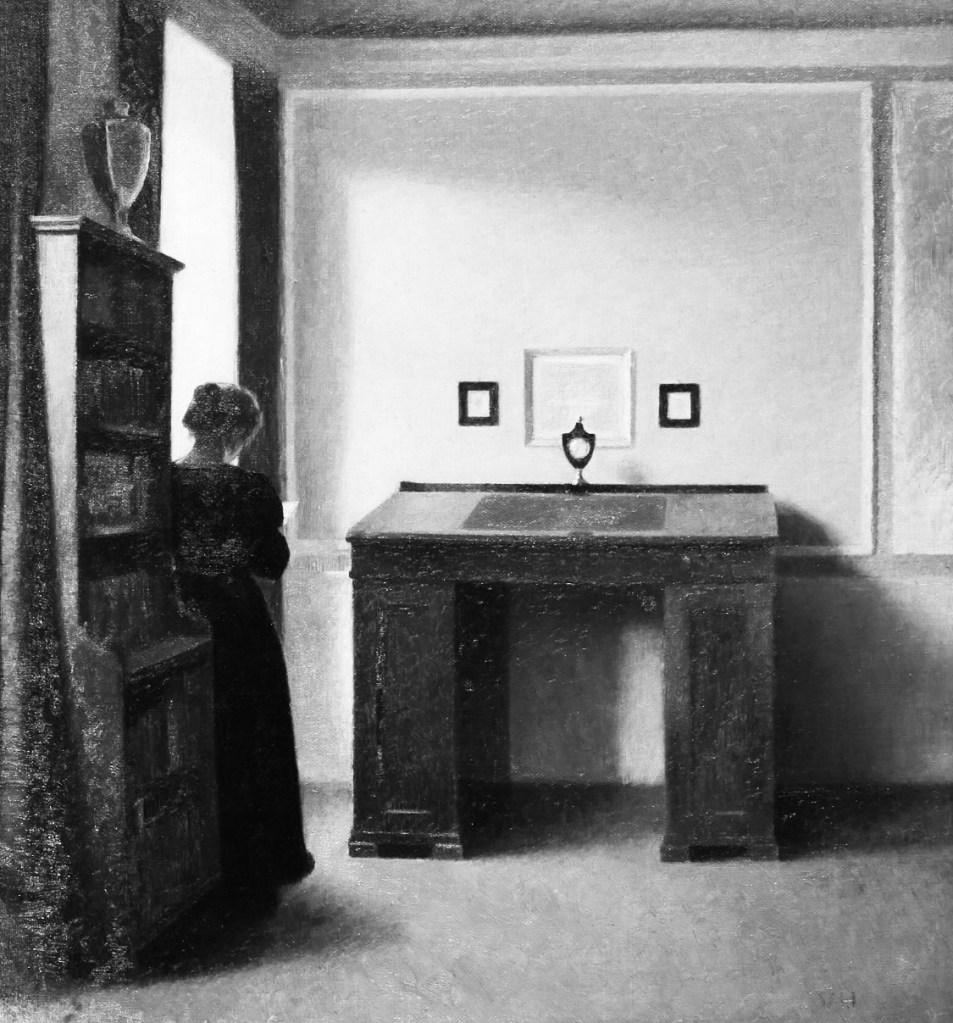
Gwen John, A Corner of the Artist’s Room in Paris, c.1907–1909. Oil on canvas. Sheffield Museums Trust
Vilhelm Hammershøi, Interior with Writing Table and a Young Woman, 1900, oil on canvas, private collection

Drawing and painting were a habit from her early years, and the strength of her draftsmanship is on display from the first room in a new exhibition at Pallant House Gallery, “Gwen John: Art and Life in London and Paris.” This is the first major showing of John’s work in twenty years, with oils, works on paper, archival material, and personal possessions. The full course of her career is traced chronologically, and the exhibition includes a select group of works from her contemporaries. In the second room, Vuillard and a marvelous Hammershøi hang close by a selection of John’s interiors. In one corner there is a small-scale plaster head by Rodin, Head of Whistler’s Muse (ca. 1906), a monument to Whistler for which John modeled.

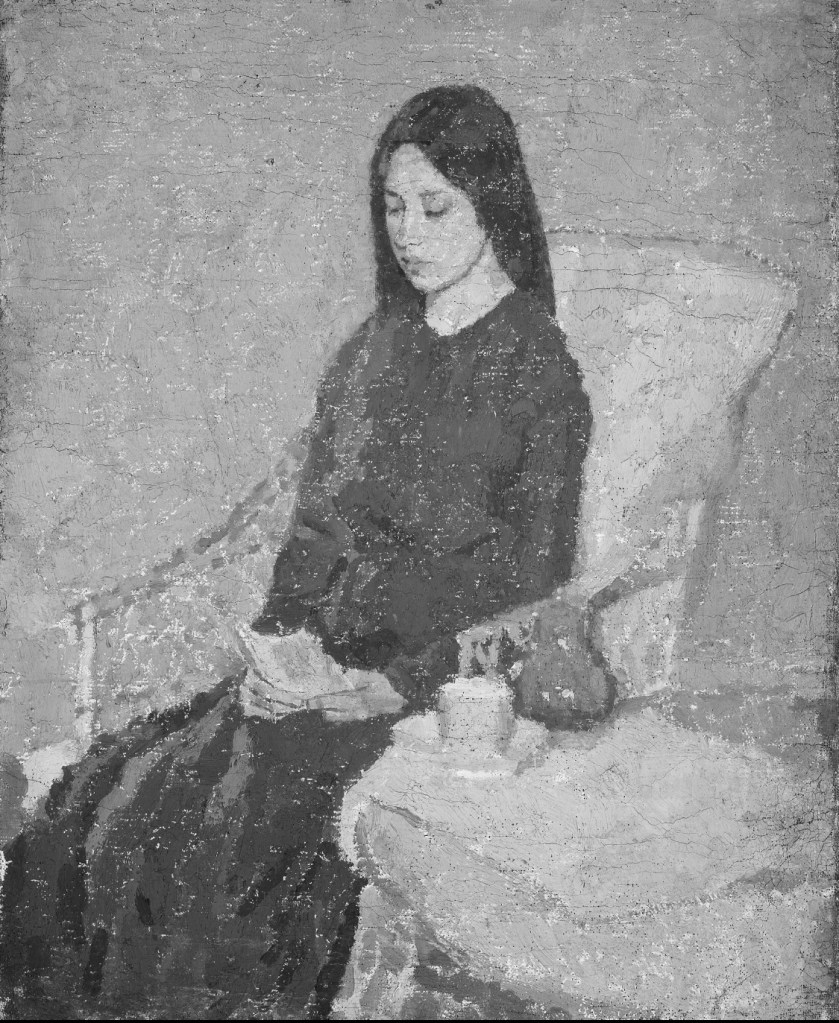
As the show progresses there is in John’s work an increasing economy of style: whether still life, portrait, or interior scene, images tend to be expressed with a more muted palette; colors lighten, diffusing into patches with little voids of finely primed canvas emerging through strokes of oil paint. Society figures are absent. Often subjects are anonymous female sitters positioned within a sparse studio interior as in The Convalescent (ca. 1923–24), The Seated Woman (ca. 1910–20), and Girl in a Mulberry Dress (ca. 1923).

Many compositions are repetitive in John’s drawings and paintings, sometimes highly so—the variations between images, often portraits, remain within a particularly narrow range. Seeing these works as reproductions does them few favors but viewing the originals hanging together, the nuances of the paintings achieve a satisfying effect, notably in one room where they sit comfortably opposite Cézanne’s oil painting Head of a Boy (1881–82).
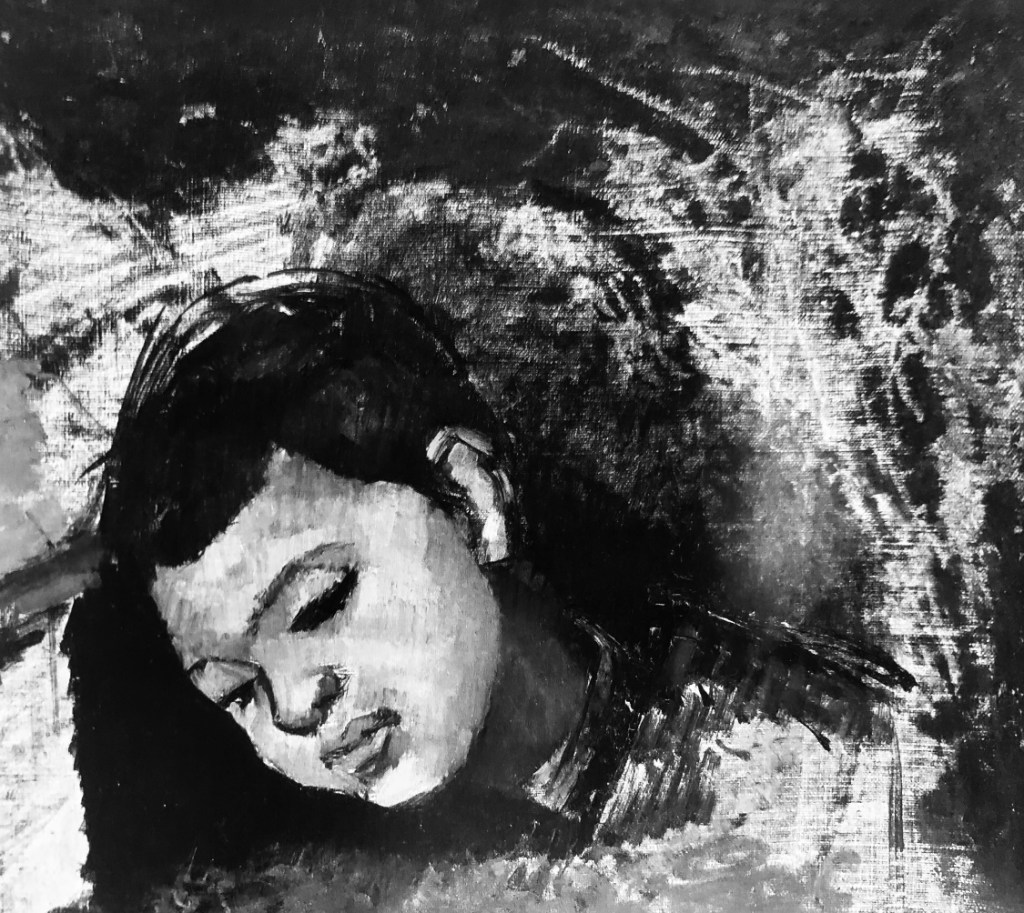
Paul Cézanne, Head of a Boy, 1881–2, oil on canvas, private collection
Gwen John, The Convalescent, c. 1923–4, oil on canvas, The Syndics of the Fitzwilliam Museum, University of Cambridge

“It is not unreasonable in Paris,” Paul Valéry observed, “to disguise what one has which is substantial and painfully acquired, under a lightness and grace which serve as a protection for the secret virtues of attentive and studied thought.” John’s art is often an embodiment of this insight. Despite her modest background, she established herself as an artist, becoming a recognized and respected figure in Paris during its modernist high tide. Following schooling at London’s Slade School of Fine Art, and further tuition under Whistler, she moved to France for good, living between the capital and its suburb of Meudon.

There on the continent, John found herself at a fountainhead of European modernism and became acquainted with many of its foremost figures: Picasso and Matisse, Braque and Wyndham Lewis, Brancusi and the poets Pound and Rilke. She became Rodin’s model and lover. It was a troubled affair, but, despite this he, like many others, esteemed her art.

This show does well to avoid focusing too much on John’s personal life as a means to understanding her art, rightly placing emphasis on her work. The once-overriding image of her as a recluse, apart from the avant-garde and intellectual currents of her time, is long gone. Given the marked increased focus on female artists in recent years, it’s surprising a figure this consistent has waited until now for a show of this standard.

The American lawyer and art collector John Quinn, an eminent enthusiast of John’s work, provided robust support, his period of patronage coinciding with her most prolific years as an artist (1910–24). He helped persuade John to part with her work as well as providing opportunities for her during wartime privations. Quinn said, “If I had to make a choice between the painting by you . . . and the Picasso, I should cheerfully sacrifice the Picasso.” Sometimes a little money and admiration are all that’s needed for encouragement.

During John’s final decade, her artistic pursuits apparently dwindled, and, due in part to illness, she became increasingly aloof and reclusive. Her work, however, remained desirable, and her family continued to offer support. The Brittany and Normandy coastlines were her retreat, and during a last visit to the sea she died in Dieppe at age sixty-three.

One leaves the show feeling John remains an underappreciated figure; putting this down entirely to her sex is unconvincing, for other twentieth-century female artists have gained much more notice. Without political diversions or manifestos, she knew her works were significant, and labored hard for them; perhaps she thought the personal cost too much and stopped her production early. Regardless of the cause, her self-imposed exile from the London scene and turn to Catholicism contributed to a body of work with an understated quietude. She reflected that for her, art came before children; who, she said, is remembered by history simply for becoming a mother?
Glyn Philpot: Flesh and Spirit at Pallant House Gallery 14 May – 23 October 2022

By Christian Kile

Aged 22, having long felt a draw to the Christian faith, Glyn Philpot joined the Catholic Church. He attained a thorough grounding in Catholic doctrine, become a founding member of the Guild of Catholic Artists and regularly attended Sunday Mass. Lacking the inclination to align himself with an artistic movement, he nonetheless did well to form ties with patrons, keeping his homosexuality discreet and steering clear of the rakish life in ‘high society’. Philpot seems to have led a sensible and generous life – not the best way to go about being remembered as an artist in the modern age, which partially explains why he has been little known. There’s not much room for God in modernism.

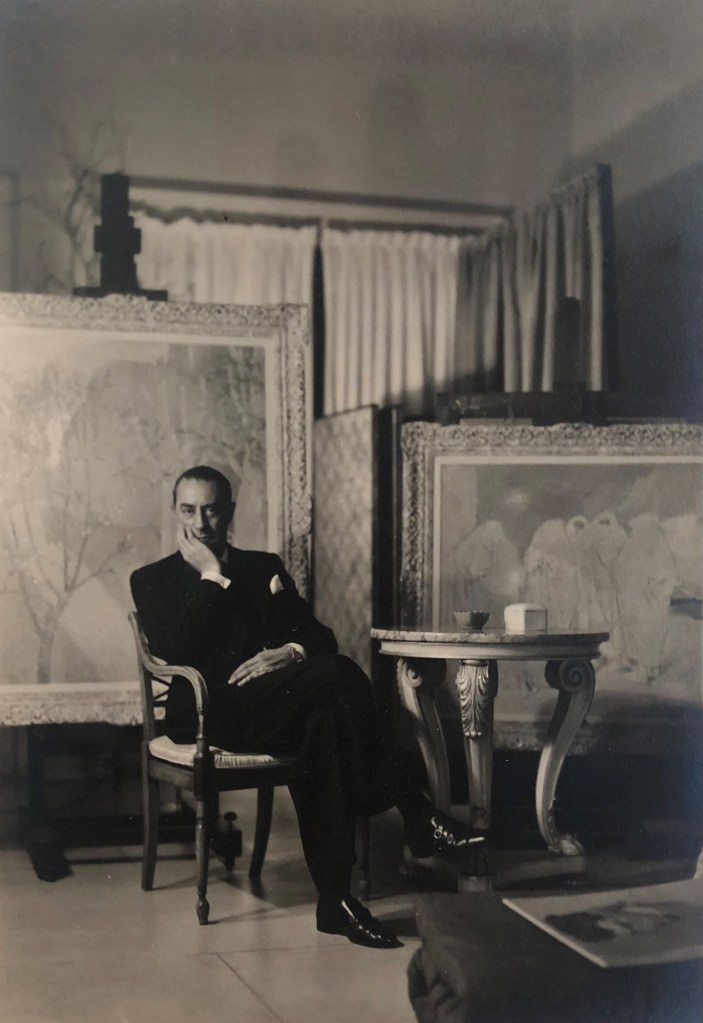
F.J. Gutmann, Glyn Philpot in the Marlborough Gate House Studio, 1937, vintage bromide print, private collection

In 1910 Philpot had his break, establishing himself with Manuelito, the Circus Boy, a picture of a young bullfighter, likened to Velazquez, that ended up in the Stedelijk Museum collection. Although Manuelito is not on show in this exhibition, it resulted in portraiture becoming Philpot’s bread and butter. After its success commissions began to mount up, some of which came from the beau monde, and all of this by the age of twenty-five, keeping him comfortable through his triumphant years (1919-1930).

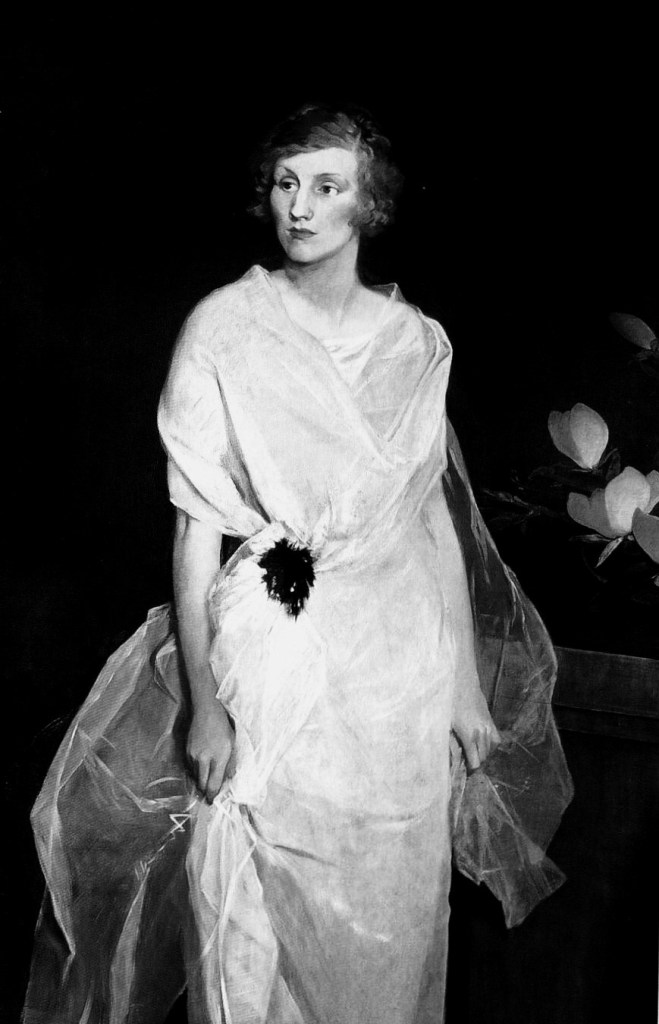
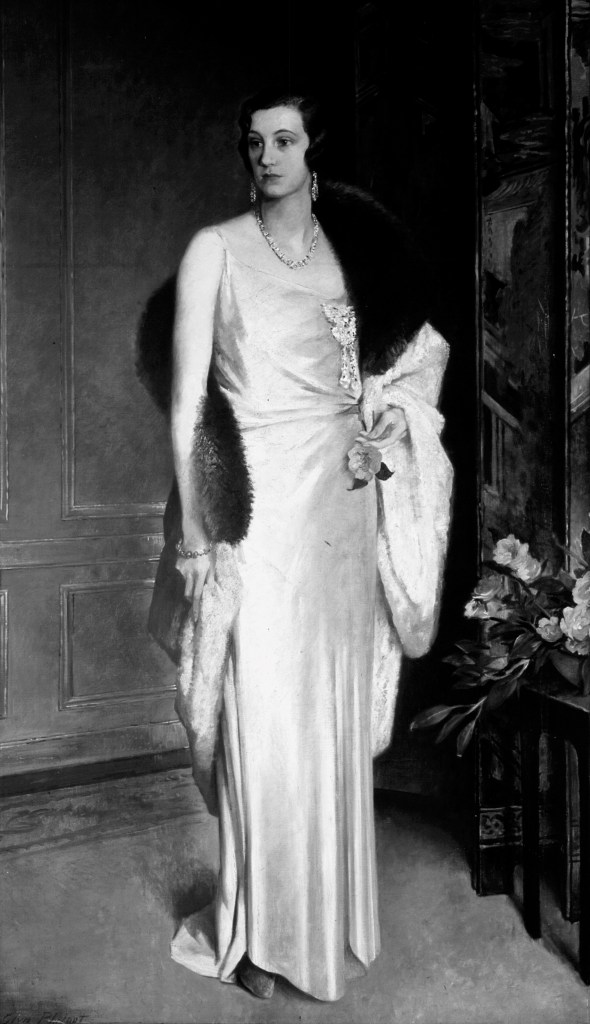
His sitters could be challenging; a long drawn out and much postponed portrait commission for the King of Egypt, Fuad I followed. There are not many society portraits in the exhibition, which is a shame, but the ones on display are among some of the best works on show. The large-scale portrait of Loelia, Duchess of Westminster– said by Tatler to be ‘squadron leader of Society’s Young Brigade’ – resembles an understated John Singer Sargent, and other similar works, such as The Countess of Dalkeith and Siegfried Sassoon made me think of these paintings as the pictorial equivalent of Powell’s A Dance to the Music of Time, with its artists and manners, and in its sexuality.

Like Powell, Philpot made it into the world of riches without being unduly seduced by it. The friendship between Philpot and Sassoon was not close, and the greatest blow for Philpot perhaps came following a dinner when Sassoon claimed that the artist just fell short of the first rank, a sure way to injure their relationship.

Loelia, Duchess of Westminster, 1929-30, oil on canvas, The Trustees of the Stanstead Park Foundation
The Countess of Dalkeith (later Mary, Duchess of Buccleuch and Queensbury), 1921, oil on canvas, by kind permission of The Duke of Buccleuch & Queensbury, KT and the Trustees of the Buccleuch Chattels Trust

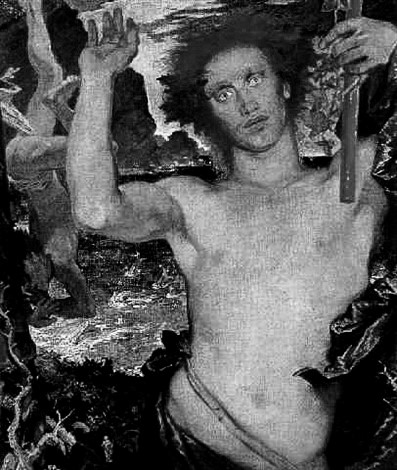
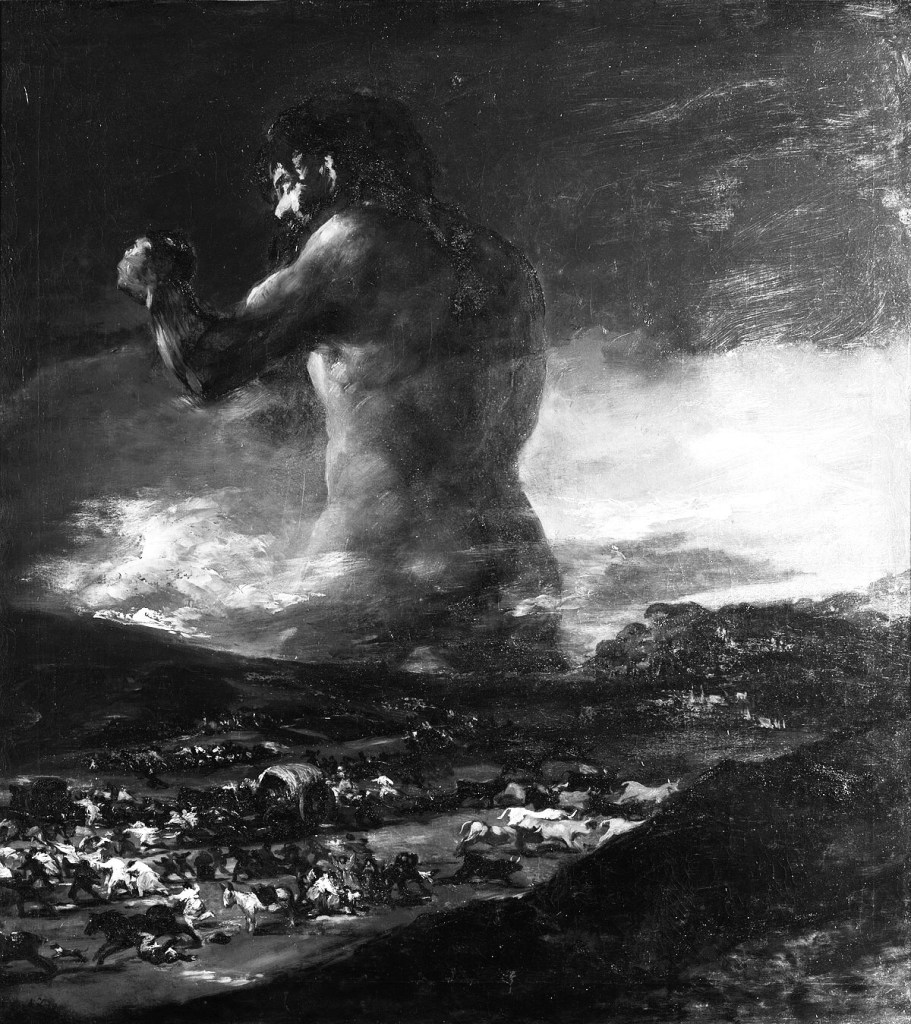
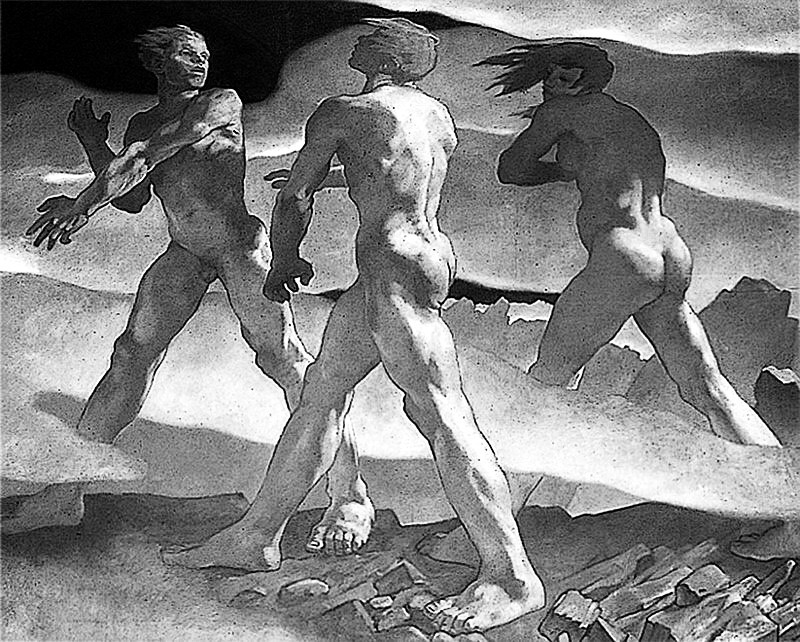
Even a quick walk through this show reveals the variety of Philpot’s work. ‘Literary’ subjects of religious, historical and mythological subjects were his preference from the start, providing a break from the social contortions required for society portraits. At times he produced thoroughly anti avant-garde works such as The Transfiguration of Dionysus before the Tyrrhenean Pirates, which has something of G.F. Watts about it, with its palette and handling of the water. Maybe the curator was feeling optimistic when describing Philpot’s The Journey of the Spirit as a ‘timeless expression of heroic masculinity.’ The figures here seem closer to the estrangement of The Colossus, now tentatively attributed to Goya.

The Transfiguration of Dionysus before the Tyrrhenean Pirates, 1924, oil on canvas, Ömer Koç Collection
Attributed to Francisco Goya, The Colossus, after 1808, oil on canvas, Museo Nacional del Prado

The Journey of the Spirit, 1921, oil on canvas, Royal Pavilion & Museums Trust, Brighton & Hove

The early 1930s brought a change of style in Philpot’s work: although the typical figurative subject matter remained, there was a move away from society portraits. This decision has been seen as a move towards a more modernist approach. However, judging by the paintings on show it looks as if Philpot found himself somewhere other than the main camps that then dominated: not necessarily high avant-garde and no longer a sure fit for the Royal Academy. His painting The Great Pan caused a stir when it was rejected on the grounds of indecency. The offence was a lick of flame which both conceals and emphasises a man’s aroused penis. The prosperity and demand for his paintings he enjoyed in the 1920s were over.

Philpot’s homosexuality and inclination to use black sitters, often for portraits, make him an obvious choice for an exhibition in 2022. There aren’t many British artists in the early 20th century who made black subjects a dignified and significant part of their work. The exhibition opens with a portrait of Paul Robeson as Othello, in 1930, the first black actor to play the role since Ira Aldrich in the early 19th century. When asked about her kiss with Robeson, co-star Peggy Ashcroft said, ‘racial prejudices are foolish at the best of times, but I think it is positively foolish that they should even come into consideration where acting is concerned.’

This is the first large scale showing of Philpot’s work since 1984 and the exposure is well deserved. It is the kind of exhibition at which Pallant House excels; exhibiting a representative number of works from an underappreciated artist; in this case, one who chose to eschew self-publicity, fashion and egoistic drama, and opted instead to work diligently and embrace experimentation.

Portrait of Paul Robeson as Othello, 1930, oil on panel, Fahd Hariri
Tom Whiskey (M. Julien Zaire), 1931, oil on canvas, private collection