Review of Anthony J. Cascardi’s ‘Francisco de Goya and the Art of Critique’

By Christian Kile

http://www.sehepunkte.de/2023/10/38493.html
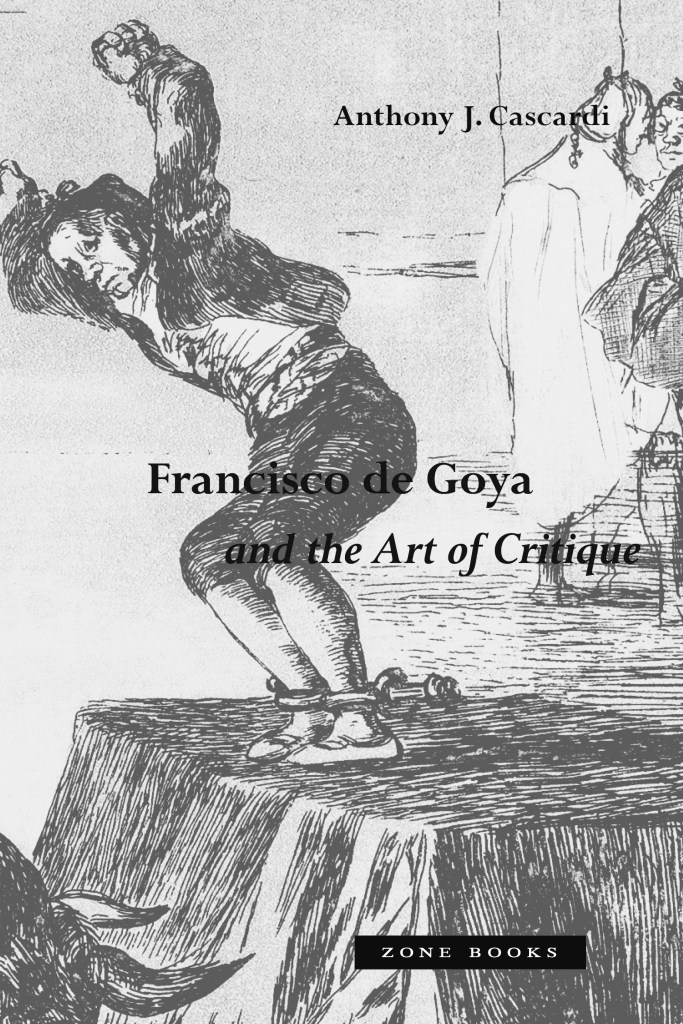
This ambitious study centres on a broad range of Francisco de Goya’s (1746-1828) work, along with its relationship to the elements of “modernity, Enlightenment, and critique.” (9) The author, Anthony Cascardi, concentrates on the artist’s paintings of polite society along with those mordant attacks on stupidity and cruelty in works such as the Caprichos and the Disasters of War, rejecting what he sees as the general view that it is mainly Goya’s darkest works which “establish his relevance for modernity”. (10)

Goya is presented as a man placed between an acutely backward Spain, lagging behind the more sophisticated civilisations of England, France and Germany which nonetheless also harbour the capacity to produce their own barbarity and limitations. Reacting to the forces of Enlightenment Europe and traditional Spain, Goya formed his project of “critique”, a technique that supplies to criticism a “self-conscious dimension that incorporates reflection on history, on tradition, on the underlying accepted categories and conditions of knowledge and belief, as well as on the medium through which these are represented.” (10)

The development of a secular nature in Goya’s work is introduced in the first chapter. His fresco, The Miracle of St. Anthony, with its stripped back religious elements, lack of a settled focal point for its subjects and its sky “vacant of anything heavenly”. (26) With his San Antonio commission that questions the traditional combinations of religious faith and painting technique, Goya may be seen as anticipating modernism, thus providing impetus for critical works probing both conventional methods of visual art and the world from which they supposedly came.

The critical strategy develops through Goya’s tapestry cartoons or large-scale oil sketches. Produced to convey “a distinctively Spanish social landscape”, certain of these works, despite their aspects of social harmony, are seen by Cascardi as including underlying elements of violence, “unsettling distortions of balance and perspective”. (55) There are intimations of the more biting images to come, like the Caprichos but Goya’s progressive political stance is somewhat repressed by the expectations of his court patrons.

To further define Goya’s contribution to a modern art, one committed to figuration and an ardent critical approach, Cascardi compares the Spaniard’s work with readings of Édouard Manet’s Execution of Emperor Maximilian, Goya’s The Third of May famously acting as its model. Another of Manet’s great images, the Dead Toreador is presented as a work of aesthetic modernism, moving away from reference to the world, reflecting on itself and “being nothing other than what it itself presents, and not anything in the world.” (95) On the other hand, Goya, with The Third of May, paints with intense emphasis a concrete event, one manifesting apparent revolt at the actions of a French regiment. Here the famous lantern at once illuminates this scene, aiding artistic representation, but also allows the regiment to make their kill. Such is the bind that the Enlightenment finds itself in, argues Cascardi, where its rationality tends to produce its own special kinds of barbarism, despite shedding a world of superstition. Within The Third of May we are presented with Goya’s own critique, that of modernity’s own flaws. Cascardi finds this tension present in Goya’s portraits too; the painting of Gaspar Melchor de Jovellanos at his Desk is said to portray a man dissatisfied by self-cultivation and a life of ‘good’ breeding. Neither are enough to stave off melancholy, boredom and scepticism.

Next, the Caprichos, an uncommissioned print series undertaken by Goya. Beginning with a self-portrait frontispiece, the remaining plates are split between the conscious or waking world, and that of nightmare. Between these two spheres, both producing their own kinds of horror, Cascardi provides some particularly engrossing readings of their text and images. The conventions of traditional perspective inherited from the Renaissance through to Velázquez give way to figurative wrenching and distortion, combined with the wit of Goya’s darkly comical captions. The critique element is seen to be born of the conviction that self-deception and virtually every other shortcoming are rife, and new methods for presentation of the world must be realised to divulge it. Critique is here defined by Cascardi as “a reflection on the limitations of the conventions of representation, including the difficulty involved in isolating a position within the social world from which to see the truths that society endeavors to hide.” (145)

Goya’s attitude towards secularization is developed further in a chapter contrasting him with the German philosopher Kant, described by the author as “wedded to the idea of reason’s autonomy […] he presupposed the irrelevance of the preexisting contexts of belief–contexts that reason saw itself as having successfully overcome.” (190)  Goya, on the contrary, made works which graphically expressed reason’s failure to achieve this Kantian design, continuing to be dogged by antiquated and base tendencies. Moreover, it could not supply an alternative salvation comparable with religion.

Goya is portrayed as an artist who feels something is terribly wrong with his world, and something ought to be done about it, but all he can do is make art about the spectacle. As Cascardi asserts, when considering Goya one should bear in mind that he challenged “the idea that any single framework of principles can underwrite the whole of cultural life.” (228)

With the Disasters of War Goya switches his gaze to “historical events” rather than the “social ones” of the Caprichos, events dealing with the most extreme violence. These works conjure both a vivid impression of wartime suffering, its mutilation and repercussions. The argument for Goya’s attitude towards Enlightenment’s deficiencies resurfaces, evidenced by French aggression, whilst the inability to turn back to a reactionary life associated with Spanish history make each unbearable in its own way. This impasse “contributes to the sense of cultural and historical dislocation in the Disasters.” (237)

Cascardi’s book complements the substantial list of earlier scholarship on Goya, through a blend of art history, intellectual history and the wider humanities. The volume integrates insights from major thinkers, expressly those of Kant and prominent writers on Goya, including Janis Tomlinson, Fred Licht, and Robert Hughes. [1] The discussion of the relationship between Goya’s tapestry cartoons and later works is especially absorbing, such as the comparison between, at first glance, the buoyant and refined Blind Man’s Buff [sic] and the crude state of aggression in the Black Painting, Duel with Cudgels.

Darkness is a word chosen frequently to describe Goya’s work. When he brilliantly exposes self-deception, wilful ignorance and corruption, it is not political,in the sense that no matter who is in charge, flaws remain, often horrifying ones, regardless of whether the artist finds a way of ‘out enlightening’ the Enlightenment.

Despite Goya’s respect and sympathy for the talents and actions of a few individuals, it is difficult to see the artist offering a panacea for the ills he pictured so mercilessly. Along with Cascardi’s admiration for the critical element of Goya’s nature, he chooses to close his chapter about the Black Paintings on a utopian note, where we encounter the author’s own bias or ideology. Throughout the book’s notes the thought of figures associated with the student upheavals of the sixties, thinkers like Althusser, Adorno, Barthes and Derrida, appear. The wide and varied range of texts contributing to Francisco de Goya and the Art of Critique suggests Goya lends himself, perhaps exceptionally, to extensive speculation, and in the case of this book prompts as much interest in the ideas of the author as its subject.

[1] Janis Tomlinson: Francisco Goya y Lucientes, 1746-1828, London 1994. Fred Licht: Goya: The Origins of the Modern Temper in Art, New York 1979. Robert Hughes: Goya, London, 2003.
Review of Michael Fried’s ‘French Suite: A Book of Essays’

By Christian Kile

http://www.sehepunkte.de/2023/01/36992.html

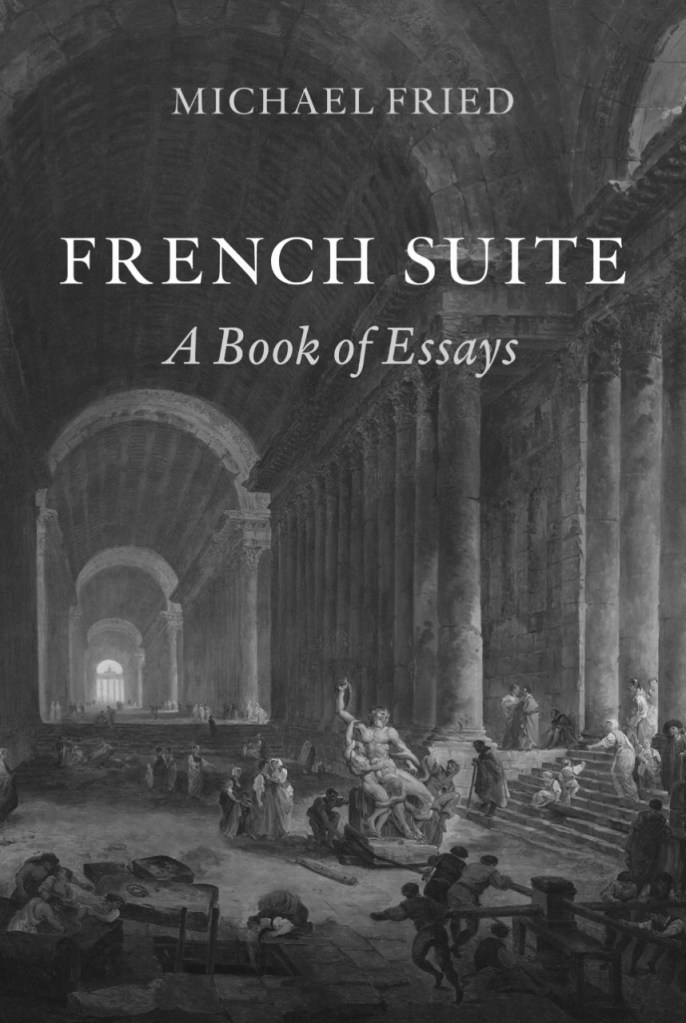
This book of essays by Michael Fried covers a selection of the painting and literature of France, focussing on the nineteenth century and Impressionism together with an argument about the evolution of French art which led to it. The ideas of Denis Diderot, a long-time influence on Fried, are central in this collection. For it is in the philosophe’s art criticism that a key criteria of French painting became defined: a will to isolate itself from, or even deny the existence of its viewer or beholder – a rejection of what Fried terms “theatricality”. To achieve this, a method of “absorption”, depicting figures engrossed in their situation and an emphasis on “dramatic unity” to achieve “a compositional effect of closure vis-à-vis the beholder” became prominent (326-327). [1]

In the first chapter it is Louis Le Nain’s group of peasant paintings which come under study with their often “strongly frontal, not to say self-presentational orientation” of figures – works which form part of the “‘classical’ turn” initiated by Nicolas Poussin (25, 36). A number of these would be to hand for Édouard Manet “at the very moment, the outset of his career as a painter of major ambition, when he could best make use of them” (48).

In 1767, Hubert Robert, mostly remembered for his paintings of classical ruins, “provoked a seriously brilliant discussion” about his Salon submissions by Diderot, then said by Fried to be at his zenith as an art critic (51). Offering an alternative to the absorptive approach, Robert’s work is conceived as “pastoral”: bridges, walkways, tunnel like spaces and differing vantage points are all utilised; an approach that encourages a viewer to enter a picture (57).

It is that Romantic icon, Raft of the Medusa by Théodore Géricault in which the theme of absorption is intensified. Fried describes the painting as having been the artist’s sole attempt at a career defining achievement, and even then, one that apparently for the artist “fell painfully short” (114). Like Keats who died a few years before him, the Frenchman would die convinced that he had not fulfilled his promise. In the Raft the shipwrecked men or naufragés are desperately baying at a distant ship on the horizon away from the beholder. Fried goes further and speculates that judging by the men’s “actions and orientation” their rescue would result in them passing from the viewer, “as if we, in our capacity as beholders, were the ultimate cause of their predicament” (105).

Along with Flaubert, Baudelaire is one of the writers allotted a chapter. Fried focusses on the latter’s Salon of 1846 where the poet-critic’s great criterion of “memorability” and its “assumption that those works of art are best that leave the strongest and most lasting impressions on the memory” is considered (118-119). Good art, for Baudelaire, eschews explicit citation of past art: “only the experience of a ‘unified’ work in the present would sufficiently recall – would lend itself to being supported by memories of – ‘unified’ works from the past” (127). Therefore, according to Fried, it is curious that Baudelaire championed Delacroix whose works often bore “unconcealed relation to famous prototypes in earlier art” (151).

Manet’s two paintings, The Luncheon in the Studio and The Balcony, are seen to mark a highly significant shift in the artist’s work in which the presence of a viewer is acknowledged with a new force. Essentially, they are portraits of Manet’s stepson Léon Koëlla and close friend and fellow painter Berthe Morisot. They signal the abandonment of Diderot’s near century long theory of absorptive criteria to produce an effect of “radical facingness”, so achieving a new way for a painting to face its beholder and bringing an end to the antitheatrical project (212). [2]

Leaving aside the landscape paintings, Fried considers the lesser known figurative works of Jean-Baptiste-Camille Corot: usually women, the models are painted in various poses; reading, playing instruments, perhaps ruminating, contemplating, or just bored. Corot continued the tradition of portraying figures absorbed in actions or thinking even though, as Fried suggests, Manet’s interventions had already established that “absorption was no longer unproblematically available for antitheatrical purposes” (260). This thinking is in line with an early decision Fried took “to become an art historian of a particular kind”, developing a highly specific narrative of art from the mid-eighteenth century onwards, based on the principles laid out in his early essay, Art and Objecthood (1967) (12).

According to Fried the work of Charles-François Daubigny is the most “seriously misunderstood” of significant nineteenth century French painters, the result of a tendency to view it firmly through the lenses of Barbizon and Impressionism (278). The “sensation” aspect central to the latter is not prominent in his work (280). Rather he is seen by Fried as closer to Courbet, his paintings regarded by some contemporaries “as evoking an extraordinary range and intensity of sensory, which is to say bodily, impressions” (305).

Pushing on into “The Moment of Impressionism”, by far the most enjoyable chapter, Fried seeks to challenge the general consensus that this movement forms one more part of French paintings continuity. He argues instead that the shift to Impressionist landscape painting marks a “fundamental break” from the antitheatrical aim (326, 341). It would be in the 1860s that the question of “neutralizing of the beholder” became untenable, with Manet’s revolutionary figurative works ending the absorptive phenomenon, which began in the mid-eighteenth century according to Fried’s model (327).

In the case of Olympia, this new shift, combined with its prostitute subject, provoked particular notoriety. In response to a used-up tradition of “absorption” Fried makes his most striking claim, that Diderot’s antitheatrical and figurative theory is superseded by a “linked series of ‘formal’ issues and demands that had no single master critic or theoretician” (351). It was Manet’s monopoly on “facingness” that led to the momentous change of representation in the Impressionist landscape, altering the course of major painting.

For Fried this switch ushers in a great shift away from ambitious figure-painting – a phenomenon which to the present has “escaped comment by students of Impressionism” and led to a new kind of unity, achieved with smaller canvasses and raising “the issue of touch, along with that of finish, to a new degree of perspicuousness” (346, 351).

Having spent much of his “critical and art-historical career” discerning his own views from those of Clement Greenberg, one of the most prominent and plainly written twentieth century art critics, it is a shame that Fried, having acknowledged his predecessor’s essays on Cézanne, amongst others, as “incontournable” found himself “defeated” at the challenge of including an essay here on the artist’s painting Mont Sainte-Victoire and the Château Noir (Bridgestone Museum, Tokyo) (10, 356).

Fried goes into great depth about the “formal” aspects of paintings, characteristically drawing rigorously on responses from contemporary critics of his chosen period and “The Moment of Impressionism” in particular presents some fascinating ideas. While the claim that it is through landscape painters that “Impressionism has come popularly to be understood in our own time” may be true it is worth pointing out the importance of other genres within Impressionism and beyond, such as Renoir’s crowds and interior scenes, Cézanne’s still lifes and peasants, and much of Caillebotte and Degas (351).

Complimenting and drawing extensively from Fried’s trilogy on the relationship between painting and beholder: Absorption and Theatricality, Courbet’s Realism and Manet’s Modernism, French Suite does not suffer too much from ‘jargon’ but when the prose does get heavy it makes Diderot’s enraptured lines all the more welcome: “One never tires of looking. Time stands still for those who admire. What a short time I’ve lived! How brief was my youth!” (63). [3]


Notes:

[1] Michael Fried: Absorption and Theatricality. Painting and Beholder in the Age of Diderot, Berkeley 1980.

[2] Michael Fried: Manet’s Modernism, or, The Face of Painting in the 1860s, Chicago 1996.

[3] Cf. [1], [2] and Michael Fried: Courbet’s Realism, Chicago 1990.