Gwen John: Art and Life in London and Paris at Pallant House Gallery 13 May – 8 October 2023

By Christian Kile

https://newcriterion.com/blogs/dispatch/tone-poems

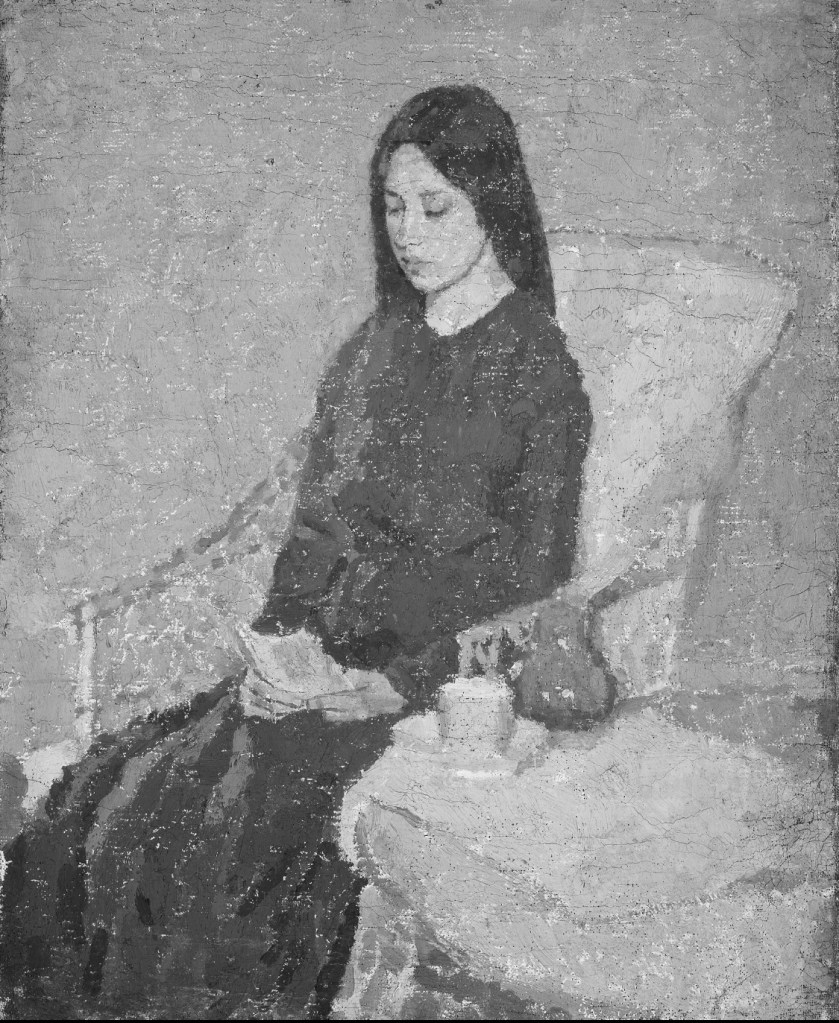
Gwen John, The Seated Woman (The Convalescent), c.1910–20. Oil on canvas. Ferens Art Gallery: Hull Museums

The essence of Gwen John’s art is summed up by her teacher James Abbott McNeill Whistler: tone. When her brother Augustus John talked about the character of her work, Whistler fired back, “Character? What’s that? It’s tone that matters. Your sister has a fine sense of tone.”

Whistler touched on something important. Gwen John’s penchant for more analytical methods, frequently returning to the same subjects, often emphasizing formal elements and with subtle variations, helps explain what makes her work so striking. Her paintings can convey a notion of “impersonality” or purity, a vital strand of modernism, more Continental in nature and closer to the maelstrom that came with the demolition of humanist optimism in the twentieth century.

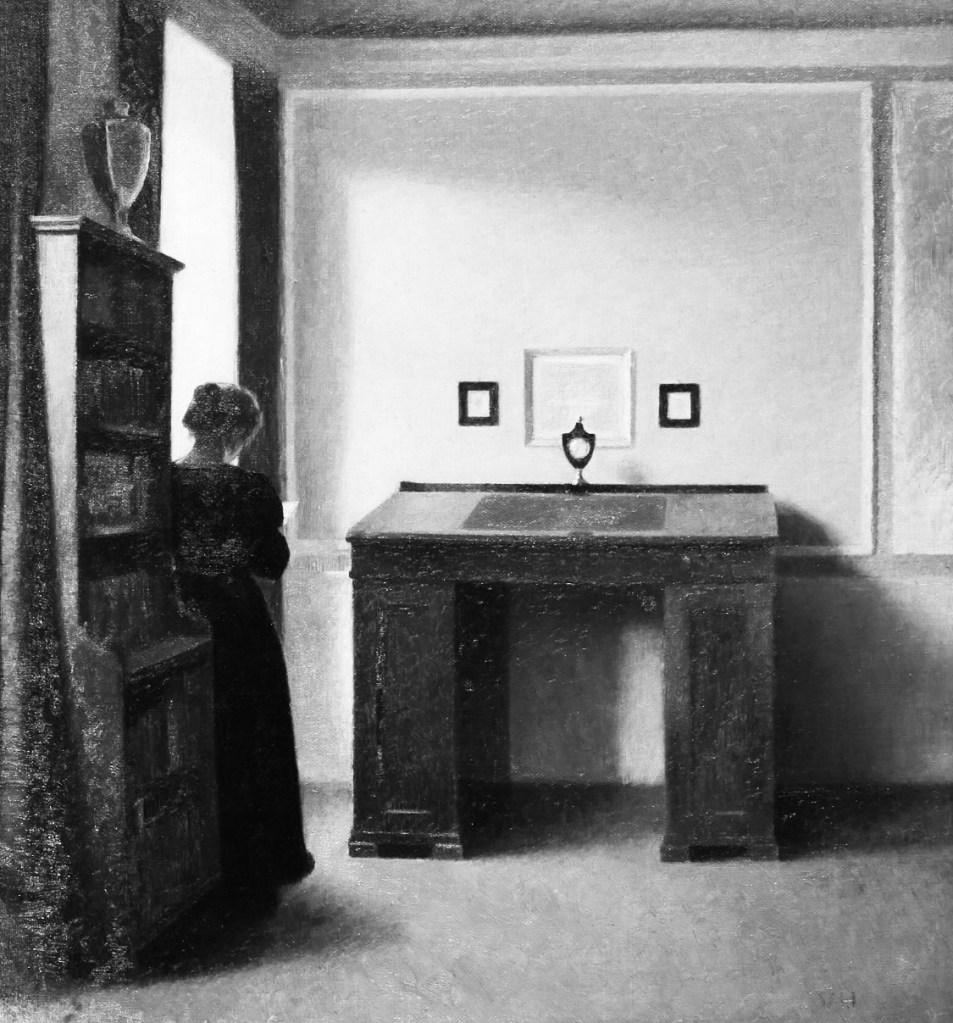
Gwen John, A Corner of the Artist’s Room in Paris, c.1907–1909. Oil on canvas. Sheffield Museums Trust
Vilhelm Hammershøi, Interior with Writing Table and a Young Woman, 1900, oil on canvas, private collection

Drawing and painting were a habit from her early years, and the strength of her draftsmanship is on display from the first room in a new exhibition at Pallant House Gallery, “Gwen John: Art and Life in London and Paris.” This is the first major showing of John’s work in twenty years, with oils, works on paper, archival material, and personal possessions. The full course of her career is traced chronologically, and the exhibition includes a select group of works from her contemporaries. In the second room, Vuillard and a marvelous Hammershøi hang close by a selection of John’s interiors. In one corner there is a small-scale plaster head by Rodin, Head of Whistler’s Muse (ca. 1906), a monument to Whistler for which John modeled.

As the show progresses there is in John’s work an increasing economy of style: whether still life, portrait, or interior scene, images tend to be expressed with a more muted palette; colors lighten, diffusing into patches with little voids of finely primed canvas emerging through strokes of oil paint. Society figures are absent. Often subjects are anonymous female sitters positioned within a sparse studio interior as in The Convalescent (ca. 1923–24), The Seated Woman (ca. 1910–20), and Girl in a Mulberry Dress (ca. 1923).

Many compositions are repetitive in John’s drawings and paintings, sometimes highly so—the variations between images, often portraits, remain within a particularly narrow range. Seeing these works as reproductions does them few favors but viewing the originals hanging together, the nuances of the paintings achieve a satisfying effect, notably in one room where they sit comfortably opposite Cézanne’s oil painting Head of a Boy (1881–82).
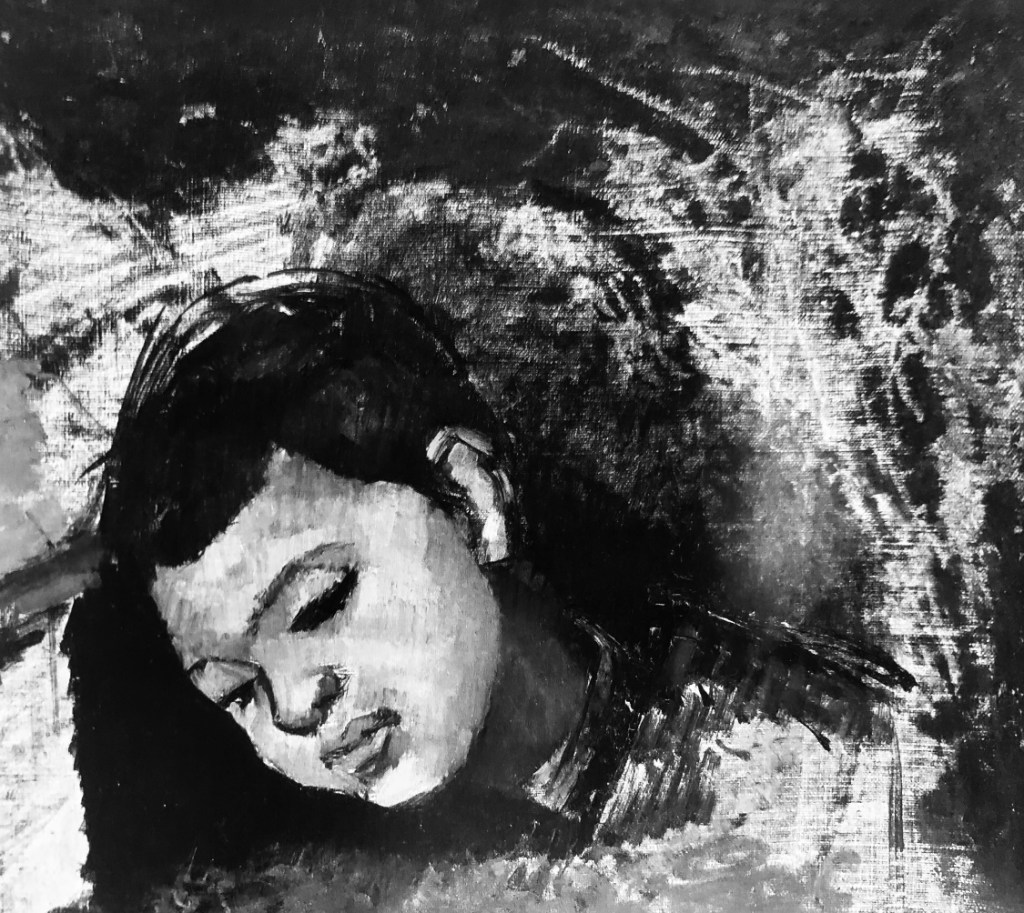
Paul Cézanne, Head of a Boy, 1881–2, oil on canvas, private collection
Gwen John, The Convalescent, c. 1923–4, oil on canvas, The Syndics of the Fitzwilliam Museum, University of Cambridge

“It is not unreasonable in Paris,” Paul Valéry observed, “to disguise what one has which is substantial and painfully acquired, under a lightness and grace which serve as a protection for the secret virtues of attentive and studied thought.” John’s art is often an embodiment of this insight. Despite her modest background, she established herself as an artist, becoming a recognized and respected figure in Paris during its modernist high tide. Following schooling at London’s Slade School of Fine Art, and further tuition under Whistler, she moved to France for good, living between the capital and its suburb of Meudon.

There on the continent, John found herself at a fountainhead of European modernism and became acquainted with many of its foremost figures: Picasso and Matisse, Braque and Wyndham Lewis, Brancusi and the poets Pound and Rilke. She became Rodin’s model and lover. It was a troubled affair, but, despite this he, like many others, esteemed her art.

This show does well to avoid focusing too much on John’s personal life as a means to understanding her art, rightly placing emphasis on her work. The once-overriding image of her as a recluse, apart from the avant-garde and intellectual currents of her time, is long gone. Given the marked increased focus on female artists in recent years, it’s surprising a figure this consistent has waited until now for a show of this standard.

The American lawyer and art collector John Quinn, an eminent enthusiast of John’s work, provided robust support, his period of patronage coinciding with her most prolific years as an artist (1910–24). He helped persuade John to part with her work as well as providing opportunities for her during wartime privations. Quinn said, “If I had to make a choice between the painting by you . . . and the Picasso, I should cheerfully sacrifice the Picasso.” Sometimes a little money and admiration are all that’s needed for encouragement.

During John’s final decade, her artistic pursuits apparently dwindled, and, due in part to illness, she became increasingly aloof and reclusive. Her work, however, remained desirable, and her family continued to offer support. The Brittany and Normandy coastlines were her retreat, and during a last visit to the sea she died in Dieppe at age sixty-three.

One leaves the show feeling John remains an underappreciated figure; putting this down entirely to her sex is unconvincing, for other twentieth-century female artists have gained much more notice. Without political diversions or manifestos, she knew her works were significant, and labored hard for them; perhaps she thought the personal cost too much and stopped her production early. Regardless of the cause, her self-imposed exile from the London scene and turn to Catholicism contributed to a body of work with an understated quietude. She reflected that for her, art came before children; who, she said, is remembered by history simply for becoming a mother?
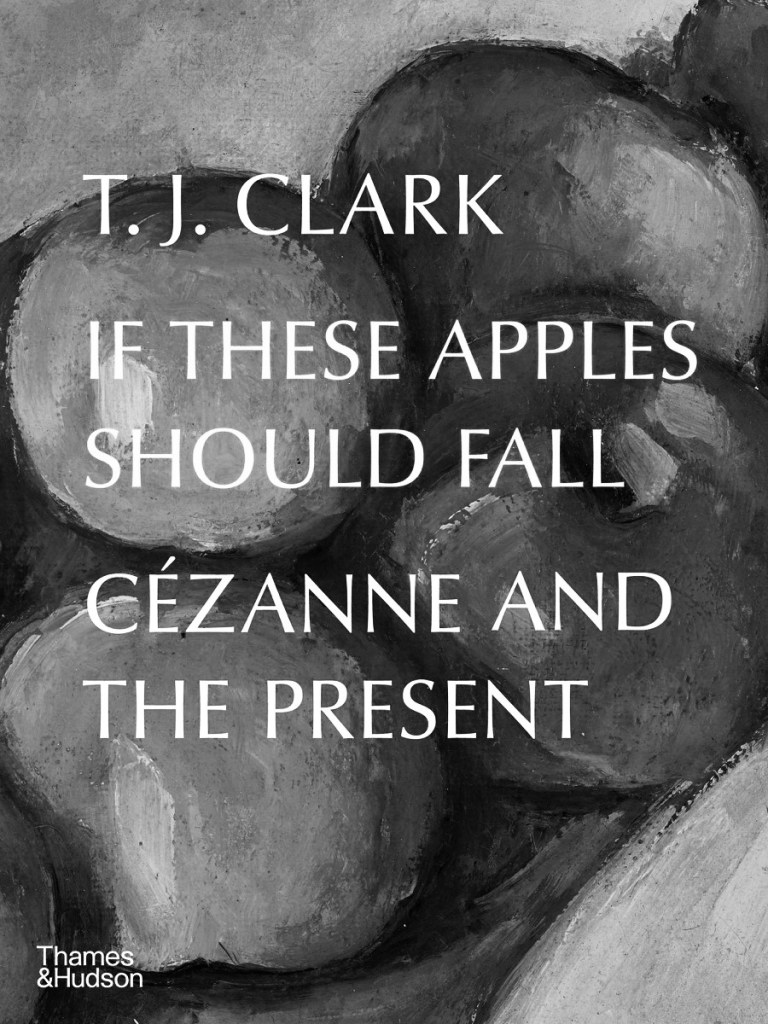
Review of T.J. Clark’s ‘If These Apples Should Fall: Cézanne and the Present’

By Christian Kile

http://www.sehepunkte.de/2022/11/37144.html

Establishing himself with two volumes on nineteenth-century French art during the Second Republic, Image of the People and The Absolute Bourgeois (1973), Timothy J. Clark took the ‘social history of art’ and refined it. His work rejected the idea of art as little more than the product of a broad context and offered closer, subtler readings, albeit with radical sympathies. The project aimed to explain the “links between artistic form, the available systems of visual representation, the current theories of art, other ideologies, social classes, and more general historical structures and processes.” [1] More work in this vein followed, most notably The Painting of Modern Life, concentrating on Impressionism and the Paris of Baron Haussmann’s reconstructions, then further into modernism and its demise with Farewell to an Idea.

Clark’s book on Paul Cézanne (1839-1906), If These Apples Should Fall: Cézanne and the Present has been years in the making, combining decades of looking and thinking about the artist. From Clark’s first memory of being struck by a reproduction of The Basket of Apples (c. 1893) the book includes chapters on Cézanne’s apprenticeship with Camille Pissarro, still lifes, landscapes, his relationship with the peasant world, and ends with the impact he had on Matisse’s work, The Garden at Issy (c. 1917). Painted during a time of world war and revolution, The Garden is said to have coincided with the period where Cézanne’s world, that of the nineteenth century, “was going down in flames” and Matisse knew it, the younger artist seeking out material from the French tradition which would prove usable, whilst Cézanne remained the “presiding deity” (17).

Despite Cézanne’s volatility in his early thirties, when he began working with Pissarro, he had already developed what Clark deems his “first style”, integrating “Courbet’s thick handling, Manet’s aggression and Delacroix’s cold lasciviousness” (23). Cézanne’s draw towards and imitation of Pissarro is seen as an attempt to transform what he had already achieved in a search for new forms, and to develop in his work the “petite sensation” – the precise meaning of which remains a mystery (42). Cézanne went as far as to closely copy one of his master’s larger landscape paintings, Louveciennes (1871), emerging as the greater artist, “more tragic and outlandish, more relentless and single-minded – and therefore modernity’s patron saint” (53).

The Getty Museum’s Still Life with Apples (c. 1893-95) provides a focal point in the second chapter. This work is accompanied by a series of detailed and wandering notes by Clark, ruminating on the painting and various other still lifes, sometimes running into trouble: “I followed the curves of the straw holder on the rum bottle for minutes – hours – on end. Even now I don’t know why” (69).

Interspersing formal readings of paintings with reflections on art historians including Kurt Badt and Meyer Schapiro, ideas from figures such as the anarchist critic Georges Lecomte and Rainer Maria Rilke, from Dante to Marx, Maurice Merleau-Ponty and Samuel Beckett, various ways into Cézanne’s works are sought. Presented as a series of notes, and with a wide range of references this section has a fragmentary quality, which seems fitting for one of the epoch’s major painters.

The chapters focused on landscapes and the card playing peasants offer more rigorous and at times insightful observations: one of the many paintings of Montagne Sainte-Victoire, from a private collection, is offered as a touchstone, “its vision of nature is both among the most openly, naively physiognomic Cézanne ever did […] The most like a body, the least like an organism. Dreamlike and machinelike” (114-115). However, there are a few long winded and abstract descriptions which do little to complement the paintings.

These protracted meanderings throughout the book remind one of the criticism made by Nicholas Penny, formerly director of the National Gallery in London, who viewed Clark as a “dangerous Marxist professor” whose prose can be “dense” and “elliptic.” [2] However, Clark’s choice of style could be explained when considering his attitude towards Clement Greenberg’s early writing, describing it as “forceful and easy, always straightforward, blessedly free from Marxist conundrums. Yet the price paid for such lucidity […] is a degree of inexplicitness – a certain amount of elegant skirting round the difficult issues, where one might otherwise be obliged to call out the ponderous armory of Marx’s concepts and somewhat spoil the flow of the prose from one firm statement to another.” [3] Stylistically, it sometimes feels that Clark has gone the other way with this book, employing dense language to avoid the shortcomings he perceives in Greenberg’s arguments. Belonging to a later generation and differing from Greenberg’s models, Clark’s arrangement of intellectual sources varies, and includes the work of theorist Paul de Man, whom he acknowledges as informing part of this book (229).

Describing Cézanne as the work’s “presiding deity” Clark discusses his place in the broader context of “modernist” art by looking at Henri Matisse’s painting The Garden at Issy (169). He argues that The Garden is almost “a deliberate art-historical marker” employed by Matisse as “palliative to the rest of the picture’s vertigo – that the little house in the garden is Cézanne. That is to say, a typical Cézanne moment” (187/189). Clark then compares The Garden with Cézanne’s Houses on the Hill (c. 1902-05).

It is at this point the book goes off at a tangent. Clark’s attention moves away from Cézanne’s influence on the Garden to other artists. A selection of explicitly political pictures is mentioned, revolutionary works from Varvara Stepanova and Jörg Immendorff. So too, is Monet’s own hedonism and Giotto with his “deep feeling for ‘nature in its barrenness'” (194). It is the Italian artist and his Dream of Joachim in the Arena Chapel that Clark views as Matisse’s “true inspiration – down even to the Cézanne-type house, since for me Joachim’s dark mountain hut finally trumps the more obvious source” (195). Although this detour doesn’t add much to our knowledge of Cézanne, it does provide an interesting insight into the author’s thinking.

The tone of Clark’s book is set with an epigraph from Ernst Bloch’s Geist der Utopie, and may be deemed provocative by some readers. Clark asserts Cézanne’s art “unthinkable […] apart from the grave dogged optimism of a long-vanished moment” (63). His work, The Basket of Apples “hates the object called modernity […] But not for a moment does the painting ask us to believe that its set-up will stave off the reality of the 1890s. Everything in the painting is falling – and where it falls to is where we are” (10).

Despite the book’s digressions and, by Clark’s own admission, “stodgy” sentences, If These Apples Should Fall provides an absorbing study of Cézanne for the early twenty-first century (117). But the fact remains that whilst the ideas are always interesting, the book is disjointed and lacks cohesion. Reading the accounts of various paintings one can appreciate the effort made to offer something fresh. Clark once observed that “left intellectuals, like most intellectuals, are not good at politics […] Intellectuals get the fingering wrong. Up on stage they play too many wrong notes.” [4] He isn’t wrong there. But they can write some intriguing books, and this is one.


Notes:

[1] Timothy J. Clark: Image of the People. Gustave Courbet and the 1848 Revolution, London 1973, 12.

[2] Nicholas Penny: “Geraniums and the River”, in: London Review of Books, Vol. 8 No. 5, 20 March 1986, https://www.lrb.co.uk/the-paper/v08/n05/nicholas-penny/geraniums-and-the-river [accessed 8 August 2022]

[3] Timothy J. Clark: “Clement Greenberg’s Theory of Art”, in: Critical Inquiry, September 1982, Vol. 9, No. 1, 141.

[4] Timothy J. Clark: “For a Left With No Future”, in: New Left Review 74 March/April 2012, https://newleftreview.org/issues/ii74/articles/t-j-clark-for-a-left-with-no-future [accessed 8 August 2022]